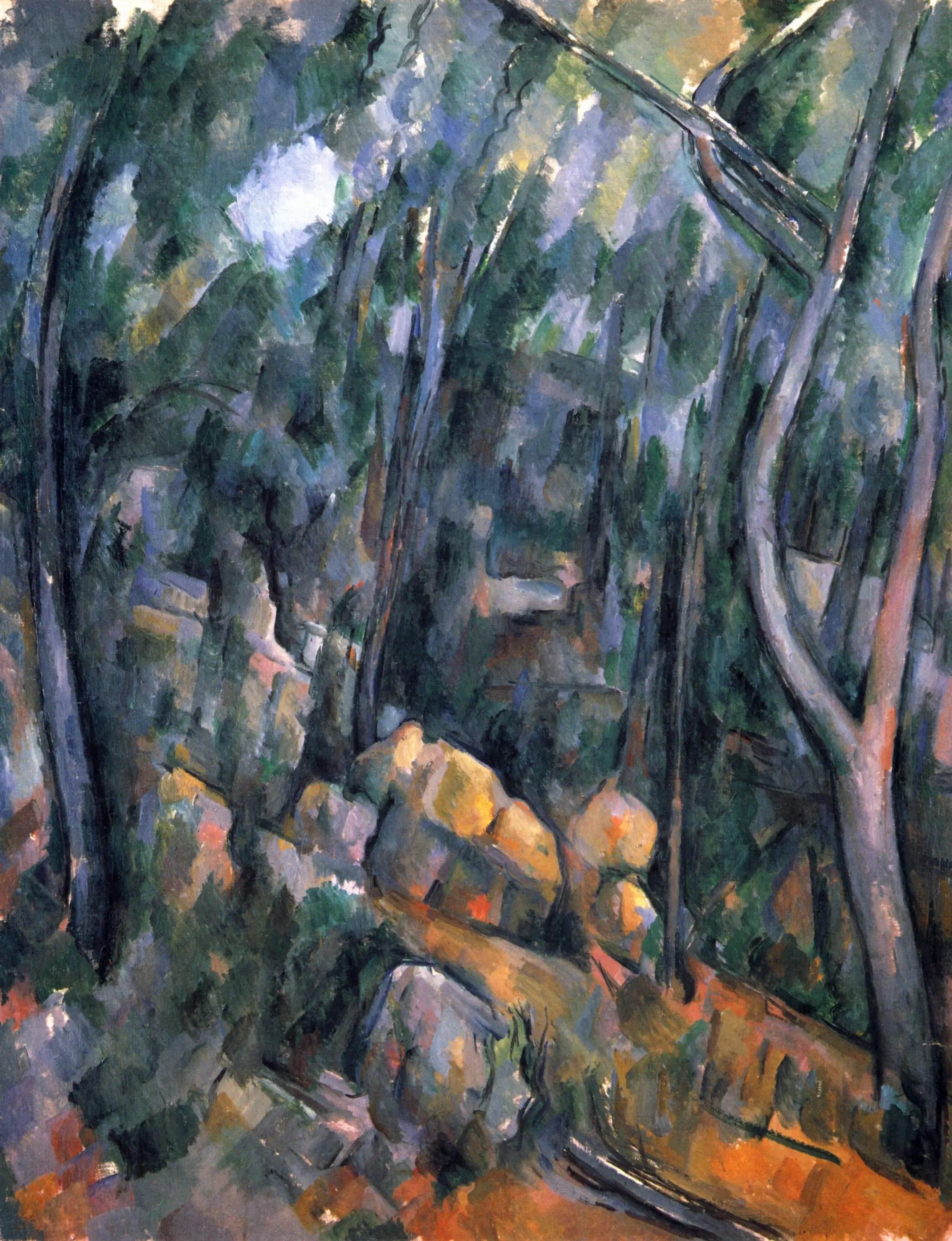
Underwood in front of the caves above the Black Castle
- Original dimensions
- 71.4 x 90.7 cm
- Museum
- National Gallery
- Year
- 1902
Scene depicted
Bringing to life a captivating landscape, this painting transports the observer to the heart of a wild and lush nature. The mysterious caves, overlooking the Black Castle, are set in an underbrush environment where every shade of green invites contemplation, establishing a lively dialogue between natural elements and geometric forms. Cézanne transforms this painting into a vibrant surge of colors and energy, capturing the very essence of his time.
Historical context
It was in 1902, in Paris, the beating heart of modern art, that Paul Cézanne , an emblematic figure of post-impressionism , brought this painting to life. Immersed in a colorful exploration and a bold composition, the canvas "Underbrush in Front of the Caves Above the Black Castle" stands as a bridge between tradition and innovation, now described within the National Gallery in London. Its generous dimensions of 71.4 x 90.7 cm make it a work of significant presence.
Place in the artist's career
This canvas stands as one of the major milestones in Cézanne's career, testifying to his artistic maturity. Positioned between "The Sainte-Victoire Mountain" and "The Card Players," it illustrates a transition towards a more personal and introspective search, where nature becomes a character in its own right, pulsating with life.
Anecdote
“Nature whispers secrets to me, I capture them with my brushes.” This sentiment undoubtedly accompanied Cézanne during the creation of this masterpiece , as he observed the light filtering through the foliage in the morning, a guiding inspiration felt in every brushstroke of the canvas .