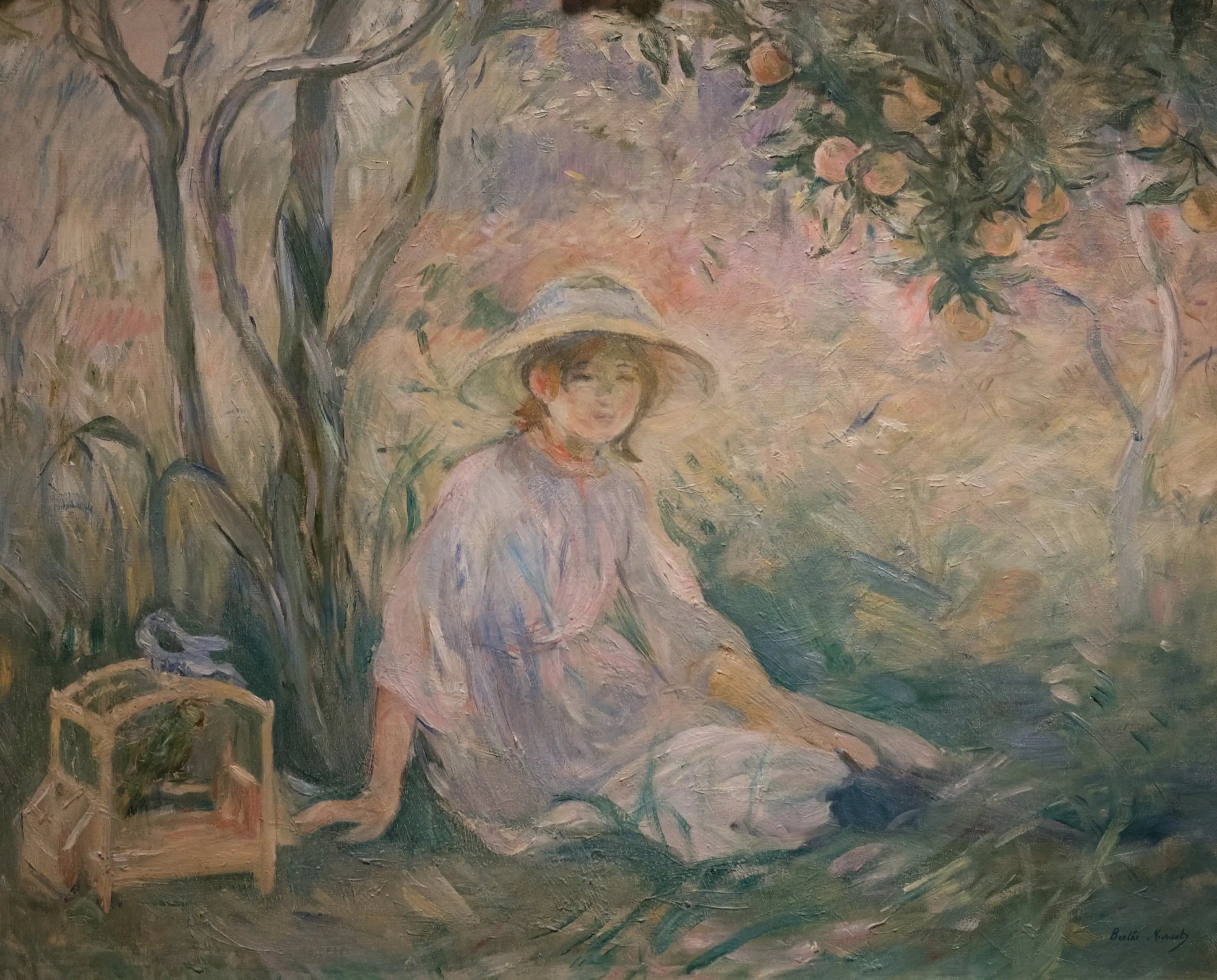
Under the Orange Tree
- Original dimensions
- 65.7 x 54.6 cm
- Museum
- Nelson-Atkins Museum of Art
- Year
- 1889
Scene depicted
In this masterpiece, Morisot offers us a view imbued with tenderness, where we see a woman resting under a flowering orange tree. The painting evokes a peaceful atmosphere, suffused with a scent of citrus, idyllic and nostalgic. The light plays on the leaves, generating a gentle ballet of reflections and values that immerse the viewer in contemplative meditation.
Historical context
Created in 1889, this painting is a major milestone of the Impressionist movement in Paris, a city in full artistic effervescence. At that time, Berthe Morisot , a leading figure of this revolutionary art, immortalizes fleeting moments, capturing vibrant emotions on canvas. Currently, the painting is exhibited at the Nelson-Atkins Museum of Art , a prestigious institution that preserves our artistic heritage. Its dimensions, 65.7 by 54.6 cm, offer an intimate view of everyday life scenes.
Place in the artist's career
This work, Under the Orange Tree, is part of the mature period of Berthe Morisot . It follows compositions like Reading (1873) and The Cradle (1872), reflecting her progression towards a deeper understanding of light and human emotions. Here, her bold use of pastel and her ability to convey feelings through everyday scenes become even more evident.
Anecdote
“I have always sought to capture the sweetness of the moment, to freeze the ephemeral.” These words from Berthe Morisot resonate with the authenticity of her canvas . It was a spring morning when the light caressed the oranges hanging from the tree, and the artist, inspired by a moment of serenity, felt the irrepressible need to convey this fragile beauty through her pictorial work.