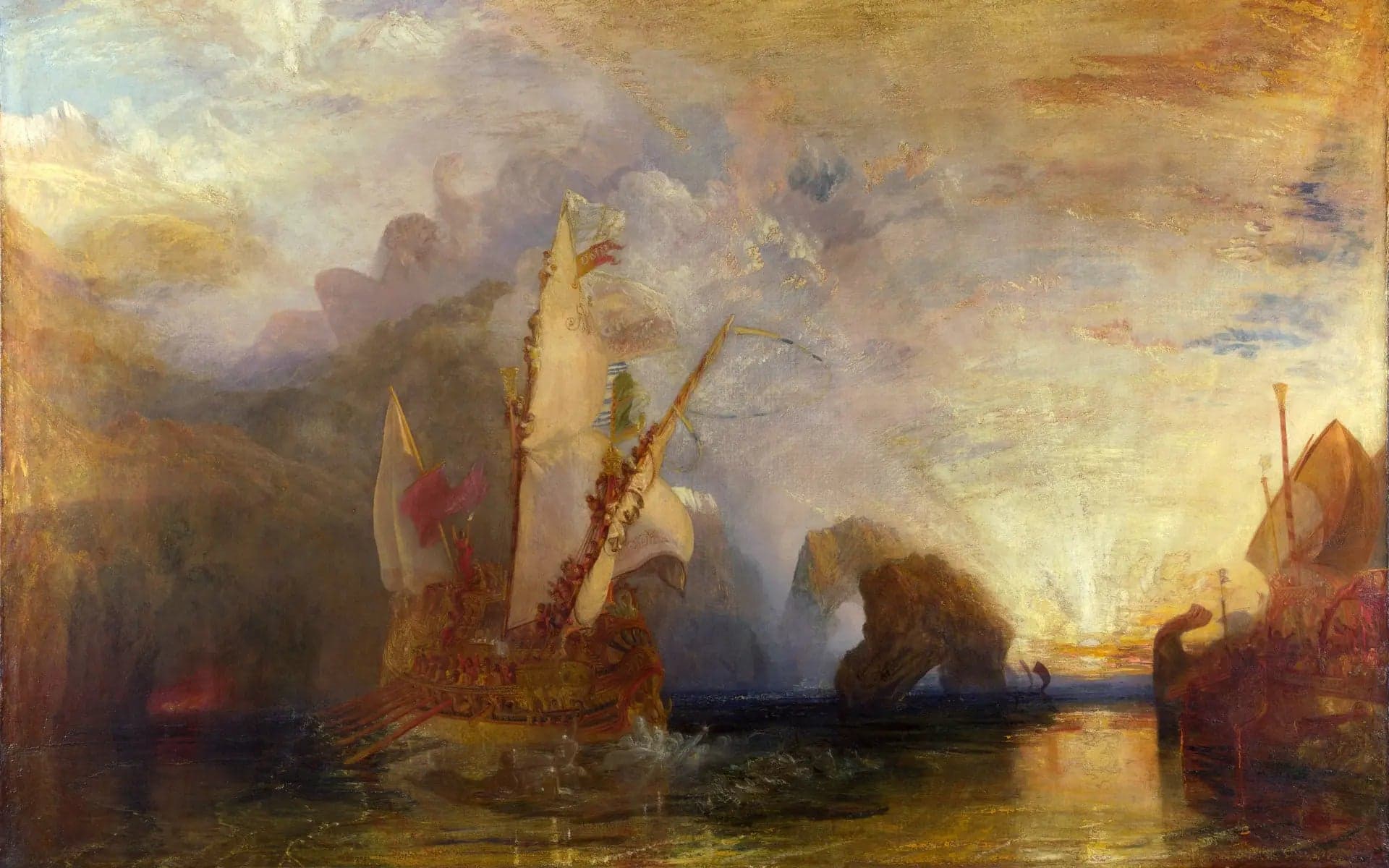
Ulysses Mocking Polyphemus
- Original dimensions
- 203 x 132 cm
- Movement
- romanticism
- Museum
- National Gallery
- Year
- 1829
Scene depicted
In this painting , the mythological episode unfolds before our eyes: Ulysse, the cunning hero, mocks the titanic Polyphème. The scene is charged with intensity, blending cunning and bravery. The tumultuous waves and stormy sky accentuate the drama, as Ulysse, aboard his skiff, provokes the anger of the cyclops. Turner transports us into this struggle between man and nature, magnifying the challenge and intelligence of the protagonist.
Historical context
Created in 1829, this painting is the result of the imagination of a master of romanticism , Joseph Mallord William Turner . Located in London, within the National Gallery, this canvas is part of a period where art sought to capture the intensity of emotions and the majesty of nature. Turner, through his work, immerses us in an epic narrative, while playing with the subtleties of light and color.
Place in the artist's career
This painting marks a significant milestone in Turner’s career, showcasing his growing mastery. It is during this period that the artist begins to explore bolder palettes and more dynamic compositions. In parallel, works such as 'The Storm' and 'The Building of the Emperor' illustrate his evolution, reinforcing his status as a pioneer of romanticism .
Anecdote
Turner reportedly stated during the creation of his masterpiece : “Light is the very essence of life, a mystery that I strive to unveil with every brushstroke.” One morning, inspired by the beauty of a sunrise over the sea, he dreamed of the contours of Ulysse se moquant de Polyphème. This light, this fleeting moment of clarity, is captured in his vibrant composition.