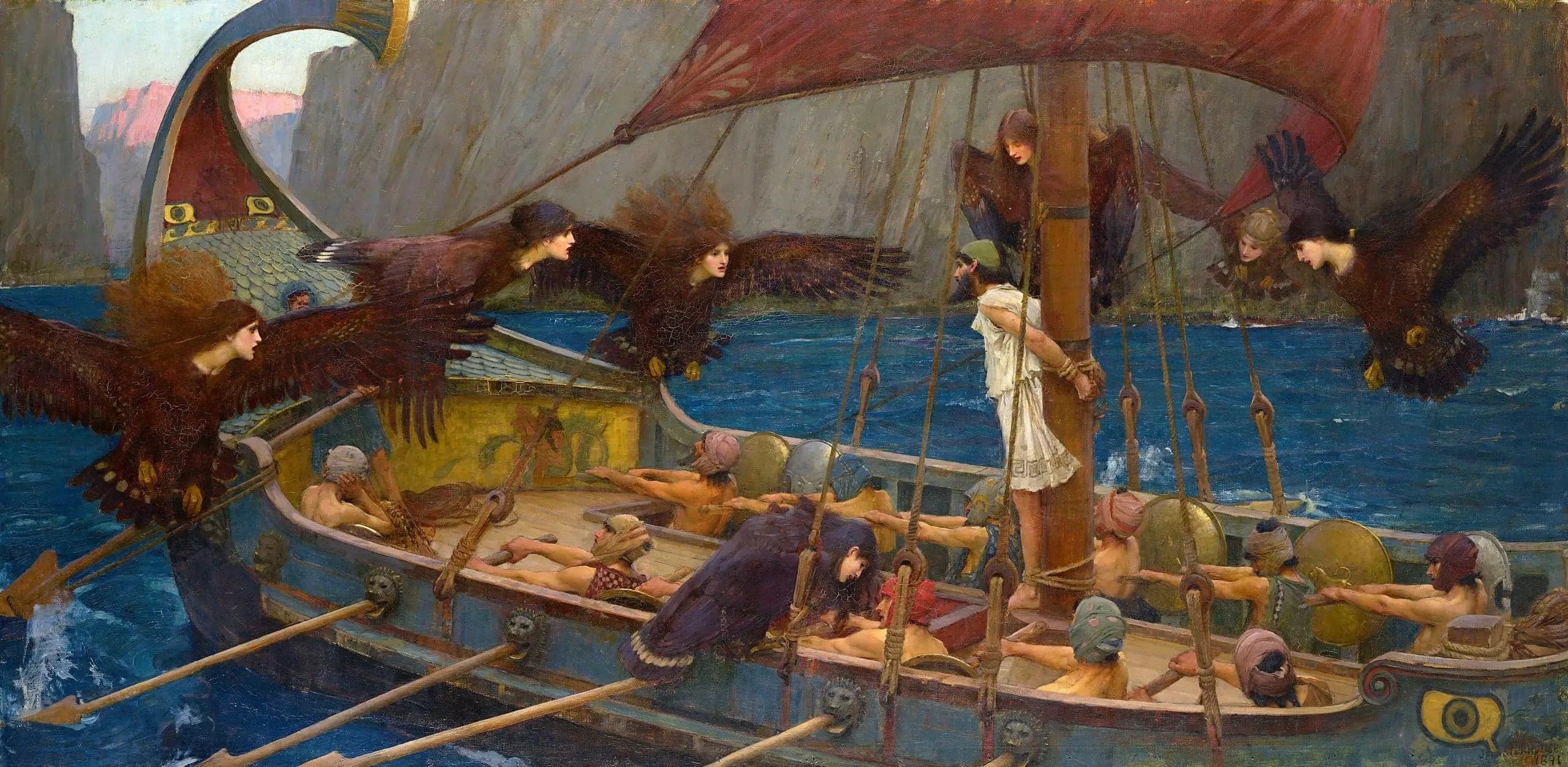
Ulysses and the Sirens
Scene depicted
In this painting, Ulysses, hero of the Odyssey, is depicted in the midst of his journey. As he is tied to the mast of his ship, he resists the enchanting call of the sirens, mythological creatures who seek to seduce him with their melodious songs. This scene, a true narrative tableau, captures the inner struggle of man between temptation and wisdom, illustrating the human dilemma through art.
Historical context
Created in 1891, this iconic painting was born in London, United Kingdom, at the height of the Pre-Raphaelite movement. This artistic current, born in the mid-19th century, advocates a return to romantic themes, inspired by mythology and nature. Currently, the painting resides in the collection of the Manchester Museums, where it is proudly displayed. Its dimensions measure 111.8 cm × 82.6 cm, a format that captures the essence of the mythological scene.
Place in the artist's career
Ulysses and the Sirens represents a turning point in the career of John William Waterhouse , marking a period when he perfectly masters his technique. This masterpiece stands alongside other notable creations such as “The Subject of the Poem” and “The Nymph of the Spring,” all testifying to his skill in playing with light and mythological themes. Each of these works guides us through different emotional atmospheres, a powerful common thread uniting his artistic journey.
Anecdote
“Art must evoke a deep emotion, a connection with the soul.” said Waterhouse, recalling the precise moment when the idea for this pictorial work appeared to him. One slightly misty morning, while contemplating the reflection of lights in the sky, he imagined Ulysses, drawn by the enchanting call of the sirens, thus embodying the struggle between desire and reason. This inspiration blends with the intensity of the painting that results, a canvas vibrant with emotions.