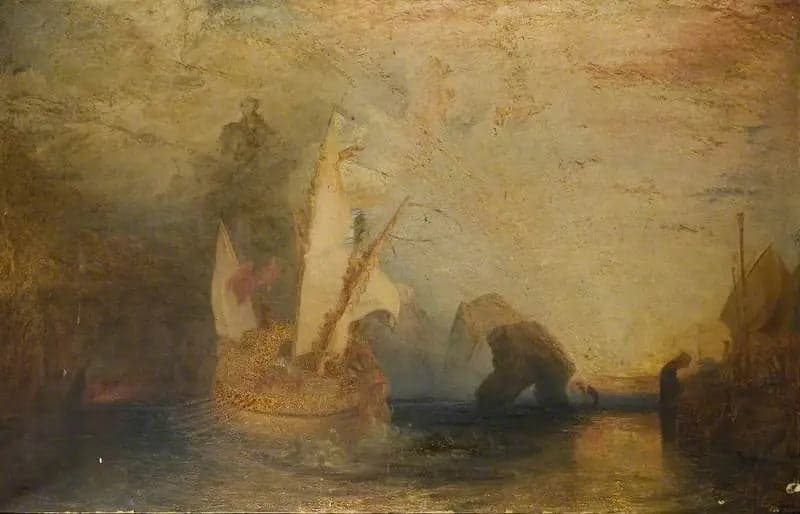
Ulysses and Polyphemus
- Original dimensions
- 122 x 69 cm
- Museum
- Saffron Walden Museum
Scene depicted
The painting “Ulysses and Polyphemus” immerses us in the heart of Greek mythology, illustrating the decisive moment when Ulysses finds himself trapped in the cyclops' cave. This masterpiece depicts an epic confrontation, filled with dramatic tension and vibrant colors. Light plays on the faces, while the shadow of the threat looms over the hero. Through this composition, Turner evokes not only a classic narrative but also an exploration of human emotions in the face of adversity.
Historical context
Created in 1829, this canvas is set in the English romantic context, a time of exploration of human passions and nature. Joseph Mallord William Turner , a pioneer of this era, captivated crowds with his bold works that defy conventions. The painting is currently on display at the Saffron Walden Museum, where its grandeur and technique continue to fascinate art lovers from around the world.
Place in the artist's career
In Turner’s career, “Ulysses and Polyphemus” represents a turning point towards stylistic maturity. At a crossroads and one of the peaks of his art, this painting evokes works such as “The Landing of the Canopy” and “Rain, Steam and Speed,” demonstrating a technical evolution that blends light and emotion. Each painting bears witness to a continuous quest for magnificence and expressive power.
Anecdote
“Inspiration is often found in the storm.” One spring morning, as Turner walked along the steep cliffs by the sea, he was struck by the raw power of nature. This scene of painting illustrates his deep connection with the landscape, capturing the confrontation between Ulysses and Polyphemus with striking intensity, linking the moment to the power of the work.