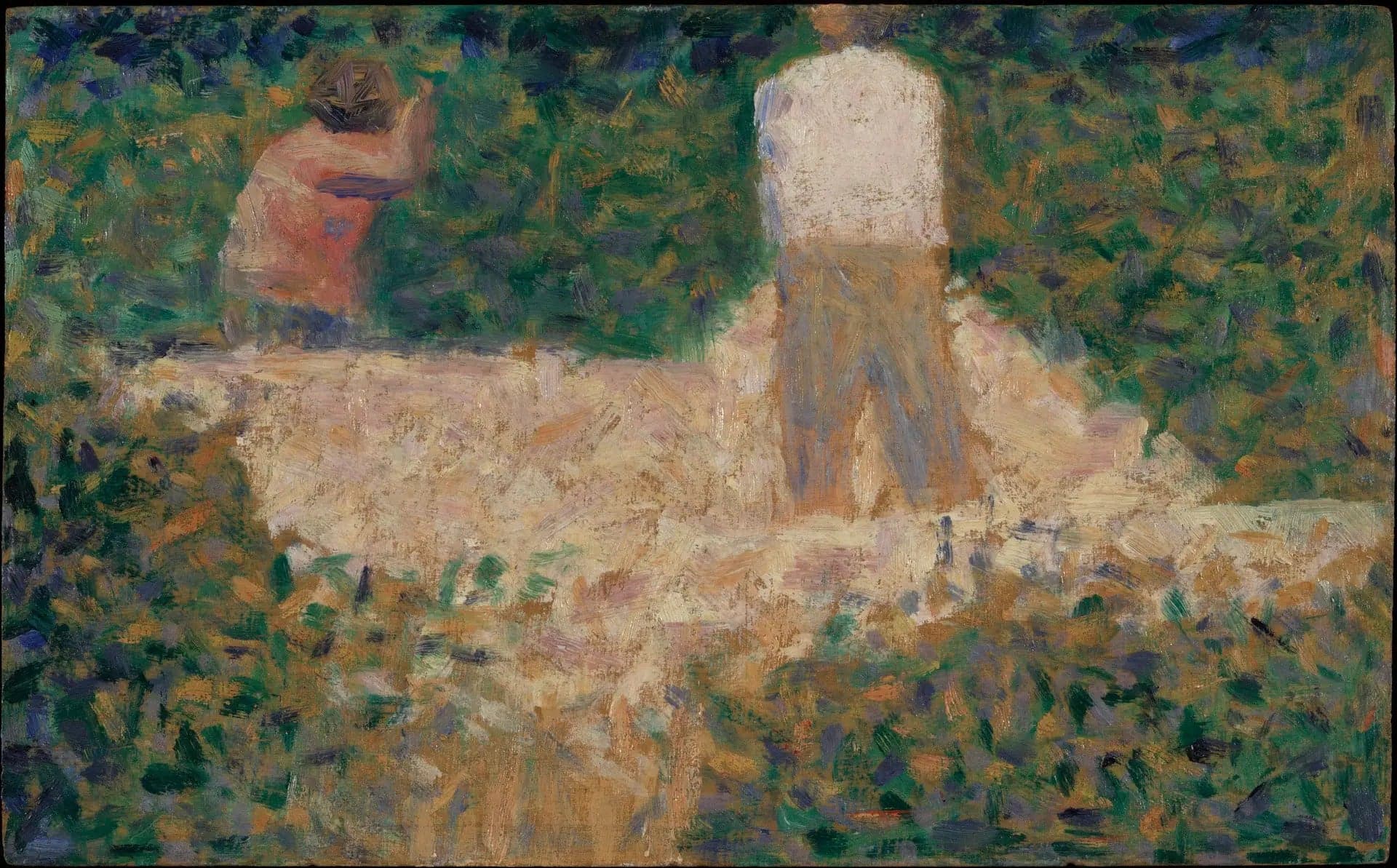
Two Stone Breakers
- Original dimensions
- 25.1 x 16.2 cm
- Museum
- Yale University Art Gallery
- Year
- 1881
Scene depicted
In Deux brise-pierres , Seurat chooses to represent the austere labor of men busy breaking stones under a bright sky. This scene, captured in the present moment, reflects a direct connection to nature and life, inviting the viewer to contemplate the harmony between man and his environment. Every detail is bathed in this particular light that explores the dynamics of collective work.
Historical context
Created in 1881, during the beautiful artistic era of France, the painting titled Deux brise-pierres is part of the neo- impressionist movement. This iconic painting, currently housed at the Yale University Art Gallery , depicts a striking scene of daily life, immortalizing workers in a moment of camaraderie and strength. The delicate dimensions of this canvas offer an intimate approach to the work, marking its importance in the artistic panorama of the late 19th century.
Place in the artist's career
This painting , carefully crafted, marks the emerging phase of Georges Seurat as an innovative artist, even before the realization of his famous canvas “A Sunday Afternoon on the Island of La Grande Jatte.” Deux brise-pierres represents a time when his style is refining, revealing a technical evolution that can easily be associated with his later works such as La Grande Jatte and Le Cirque , each testifying to a continuous maturation.
Anecdote
“Beauty lies in every moment of shared effort, even under the blazing sun.” This quote from Georges Seurat resonates with the essence of the masterpiece that is Deux brise-pierres . The inspiration for this painting emerged in the heart of a morning imbued with soft light, capturing the essence of the hard work of men who, amidst the dust and the cries of birds, strive to shape their world.