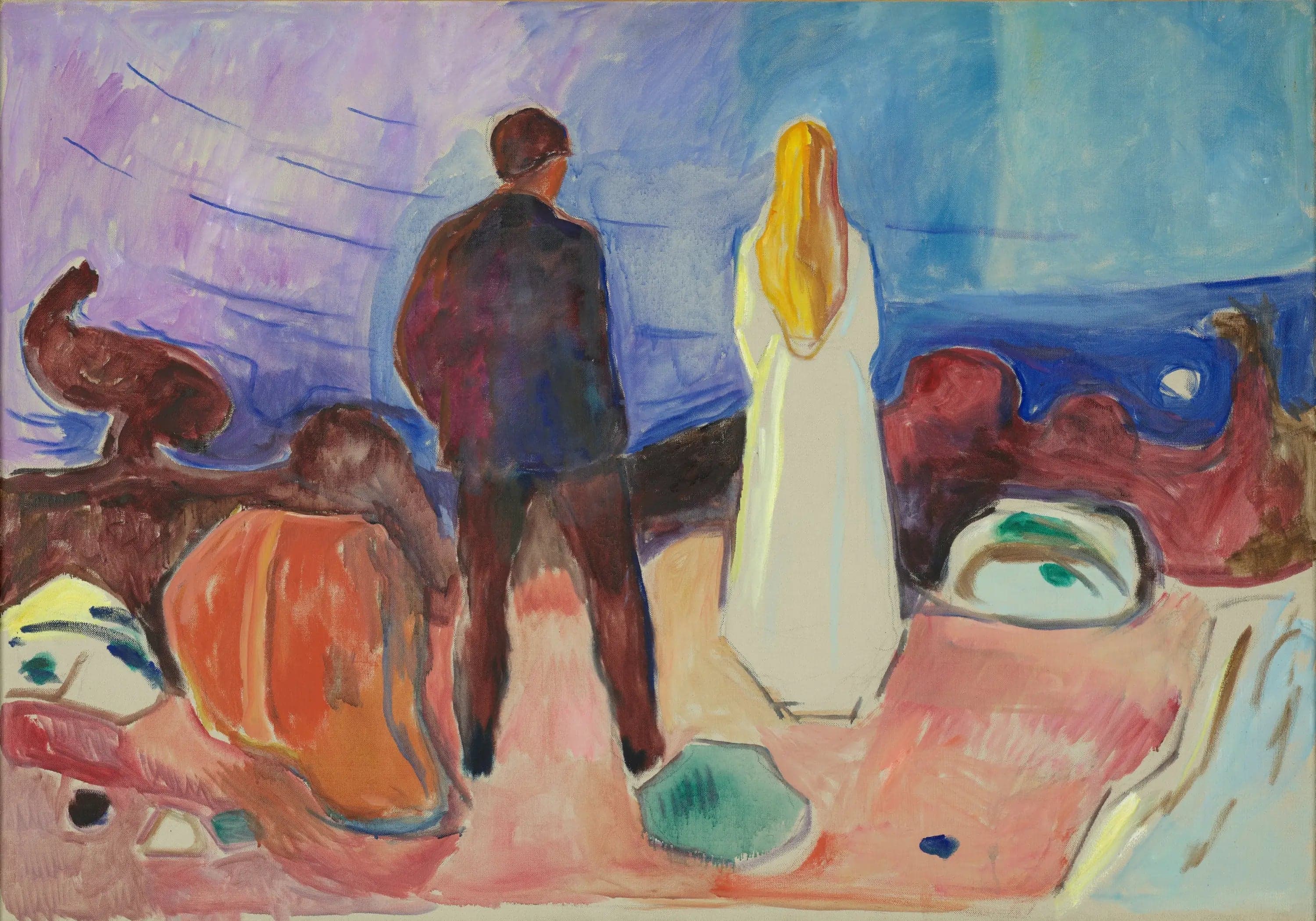
Two Human Beings. The Solitaires
- Original dimensions
- 129.5 x 91 cm
- Museum
- Munch Museum
- Year
- 1935
Scene depicted
The canvas “Two Human Beings. The Solitaires” takes us into a universe where solitude inhabits each protagonist. Two figures, both distant and connected, stand at the edge of an almost abstract landscape. The heavy and melancholic atmosphere brilliantly illustrates the complexity of human relationships. The composition highlights the vulnerability and anxiety of social isolation, treated with a disturbing simplicity.
Historical context
Created in 1935, this painting comes to life in Oslo, Norway, at the heart of the expressionist movement. Most of Edvard Munch 's works, including this canvas , are characterized by an intense emotional style, capturing the tensions of the human soul. Currently exhibited at the Munch Museum, this masterpiece pays tribute to the introspection and melancholy, I must say almost palpable, that permeates every brushstroke.
Place in the artist's career
This canvas is situated in a period of maturity for the artist, revealing the peak of his distinctive style. Alongside “The Madonna” and “The Scream,” one can observe both stylistic and emotional evolution, where Munch refines his use of color and line to explore themes of suffering and anxiety. This work thus fits into a trilogy of experimentation, marking a new stage in the visual and personal significance of the artist regarding his own emotional feelings.
Anecdote
“Every human being is a solitary in the world,” Munch is said to have remarked one day while reflecting on his painting . It is in the intimacy of a winter morning, enveloped by silence, that he would have found inspiration for this composition, overflowing with emotion and authenticity. The face of a friend encountered in a peaceful street, the light tracing delicate shadows on the walls – so many memories that nourished the artist's spirit, and which then express themselves through this unforgettable painting.