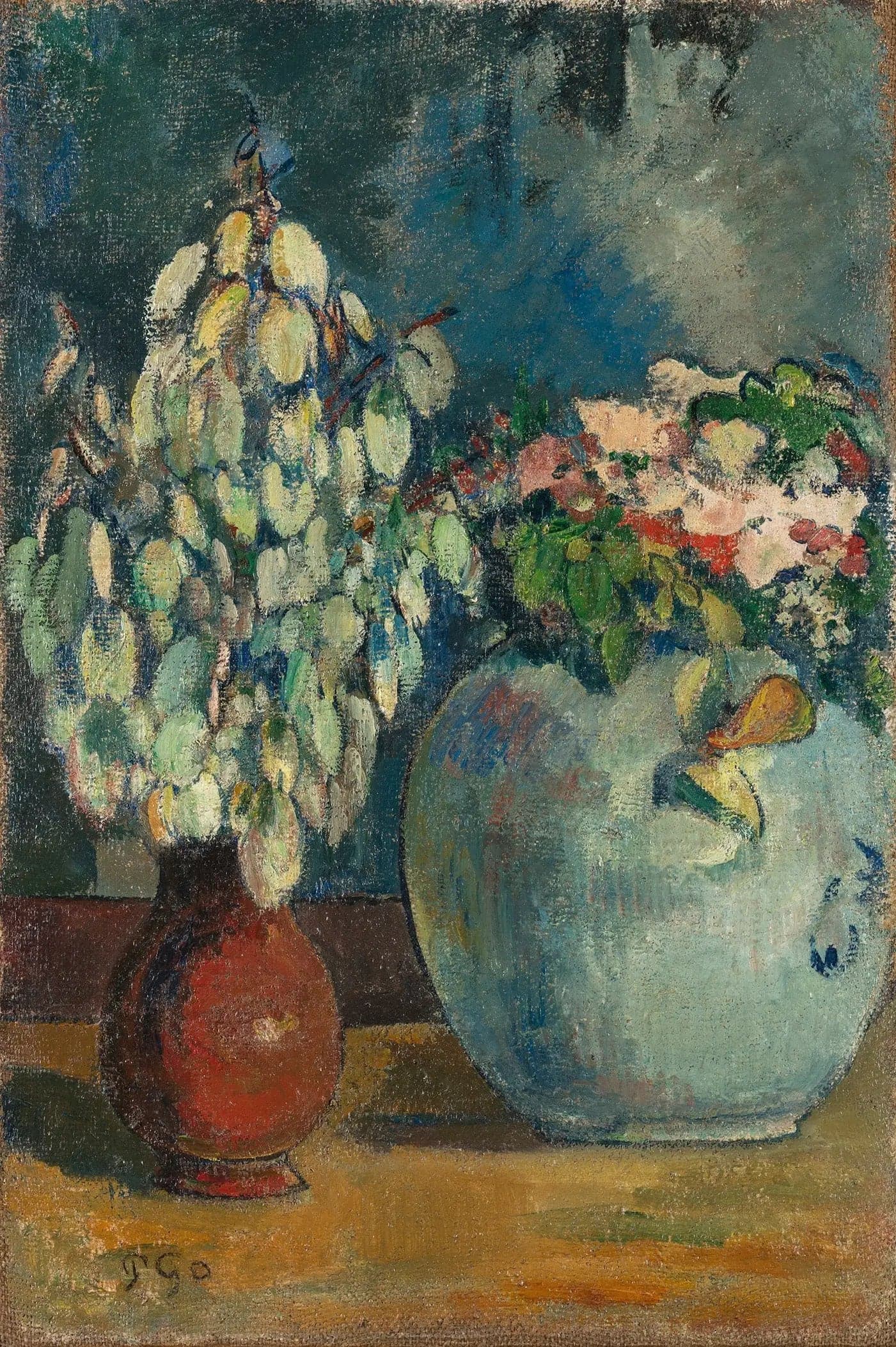
Two Flower Vases
- Original dimensions
- 43.5 x 65 cm
- Museum
- Ordrupgaard
- Year
- 1890
Scene depicted
At the heart of this painting , two delicately adorned vases rise gracefully, captivating the gaze with the lushness of the bouquets they hold. The flowers, at the peak of their brilliance, seem to tell a story, revealing a universe where radiant beauty harmonizes with the everyday. The absence of distinctive decor highlights the purity of forms and hues, inviting a serene contemplation of nature.
Historical context
Created in 1890, the canvas Two Vases of Flowers by Paul Gauguin is rooted in the excitement of the post-impressionist movement. Celebrated for its bold colors and innovative approach to composition, the work emerges at a time when art begins to emancipate itself from academic conventions. Currently exhibited at the Ordrupgaard museum, this painting embodies the essence of a vibrant era, through its generous dimensions of 43.5 x 65 cm.
Place in the artist's career
Two Vases of Flowers stands as an important milestone in Gauguin's career, marking a stylistic turning point while being a precursor to his future artistic explorations. Alongside Vision After the Sermon and The Nap , this painting shows the evolution of his pictorial language, oscillating between figurative representation and emotional abstraction.
Anecdote
“Nature is my greatest treasure,” Gauguin is said to have remarked, inspired by the flowers that adorn a bright morning. It is in the softness and fragrance of the gardens of Pont-Aven that he drew the strength for this pictorial work . The canvas delicately testifies to this encounter between the artist and floral beauty, creating a composition where each color evokes a singular emotion.
Major exhibitions
Impressionist Treasures impressionists