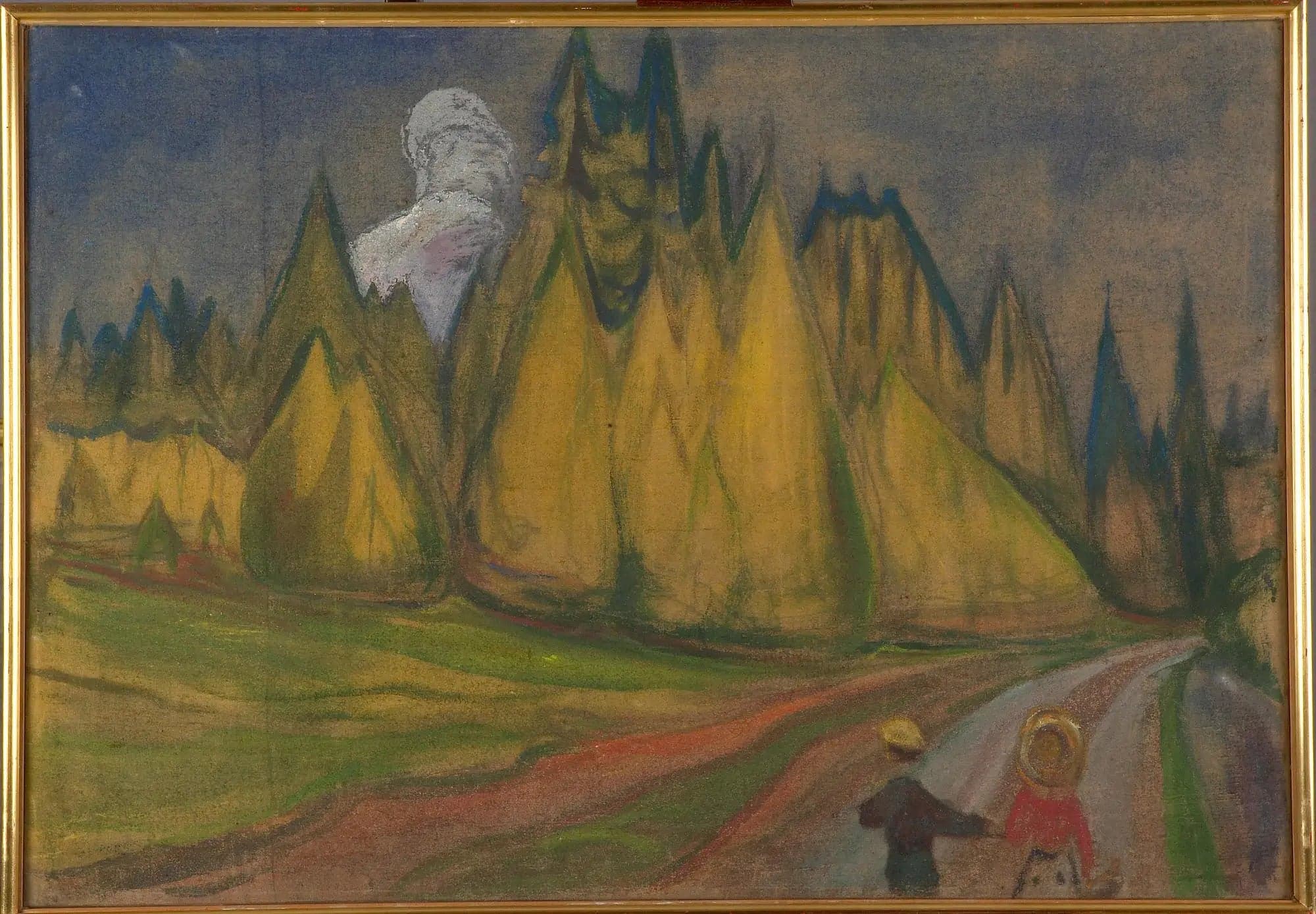
Two Children on the Path to the Enchanted Forest
- Original dimensions
- 121.5 x 85 cm
- Museum
- Munch Museum
- Year
- 1901
Scene depicted
The canvas immortalizes a dreamlike scene where two carefree children walk along a forest path. Light filters through the branches, creating patterns of chiaroscuro that dance on their faces. This pictorial work evokes the serenity of childhood promises, between the mystery of a color-rich forest and the simplicity of pure happiness. The essential characteristic of childhood, between reality and the imaginary, thus resonates in every brushstroke of Munch.
Historical context
Created in 1901, this painting emblematic of Edvard Munch finds its roots in Oslo, Norway. Munch, a leading figure of symbolism , is part of an artistic movement exploring the human psyche and emotion through vibrant colors and bold shapes. The canvas , now preserved in the Munch Museum, transports us to a time when art aimed to be more introspective and emotional, reflecting the internal struggles of the artist and his era.
Place in the artist's career
This canvas marks a significant milestone in the career of Edvard Munch . At this time, the artist oscillates between works such as The Scream and The Madonna , marking a phase of emotional maturity. Indeed, Deux Enfants sur le chemin de la forêt enchantée reveals a turning point in his technique, where the lightness of the composition is illustrated in a more accessible style while remaining intimately linked to his deep concerns about life and death.
Anecdote
Edvard Munch once stated: “The painting is the soul printed on the canvas.” This reflection drove him to capture the purity of childhood in Deux Enfants sur le chemin de la forêt enchantée . Inspired by a bright morning, he recalls the laughter of children playing in the forest, their cries resonating amidst the dancing leaves, making this masterpiece alive with emotions and vibrant in its return to innocence.