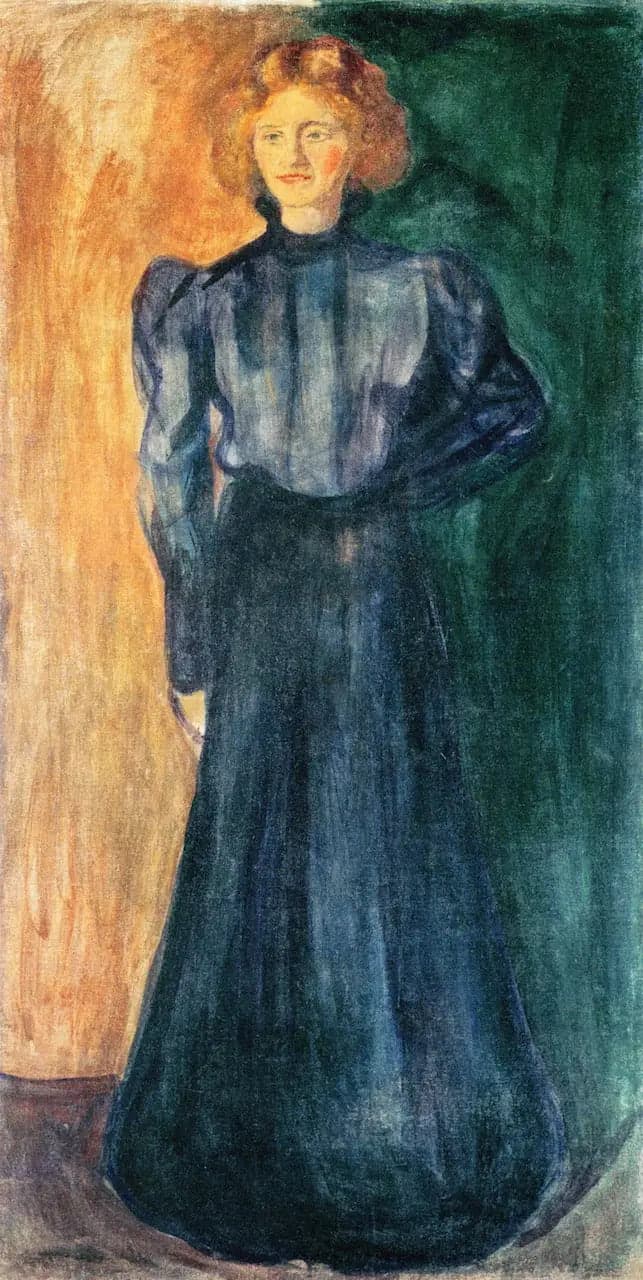
Tulla Larsen
- Original dimensions
- 38 x 46 cm
- Museum
- Stenersen Museum
- Year
- 1898
Scene depicted
The painting “Tulla Larsen” presents a striking portrait of a woman whose melancholic expression pierces the viewer. She appears floating, lost in her thoughts, as if the outside world could not reach her. It is a scene imbued with softness, where Munch sublimates his model through shades of color and delicate lines, managing to capture the sensitivity of a soul. Each brushstroke is an invitation to dive into the intimacy of this pictorial work .
Historical context
This iconic painting , created in 1898, emerges in the context of Oslo, formerly Christiania, a vibrant city that plays a central role in the expressionist movement. At this time, Munch reinvents our perception of emotions through art that captures the human soul in all its complexity. Tulla Larsen , endlessly admired, finds refuge in the Stenersen Museum, where her painting engages with the gazes that approach it.
Place in the artist's career
Tulla Larsen marks a crucial turning point in Munch's career, where his style evolves towards a bolder exploration of human emotions. This painting stands as a mirror to other great works like “The Scream” and “The Madonna,” marking a bold step towards expressionism in all its splendor.
Anecdote
“Every face I encounter carries with it a story that remains written on the canvas of my memory.” These words resonate when evoking the genesis of this masterpiece . Imagine Munch absorbing the light of a spring morning, encountered at the turn of an alley where the sweet scent of flowers intertwines with the bustle of the city. It is from this suspended moment that the evocative power of Tulla Larsen is born.
Major exhibitions
Edvard Munch : portraits