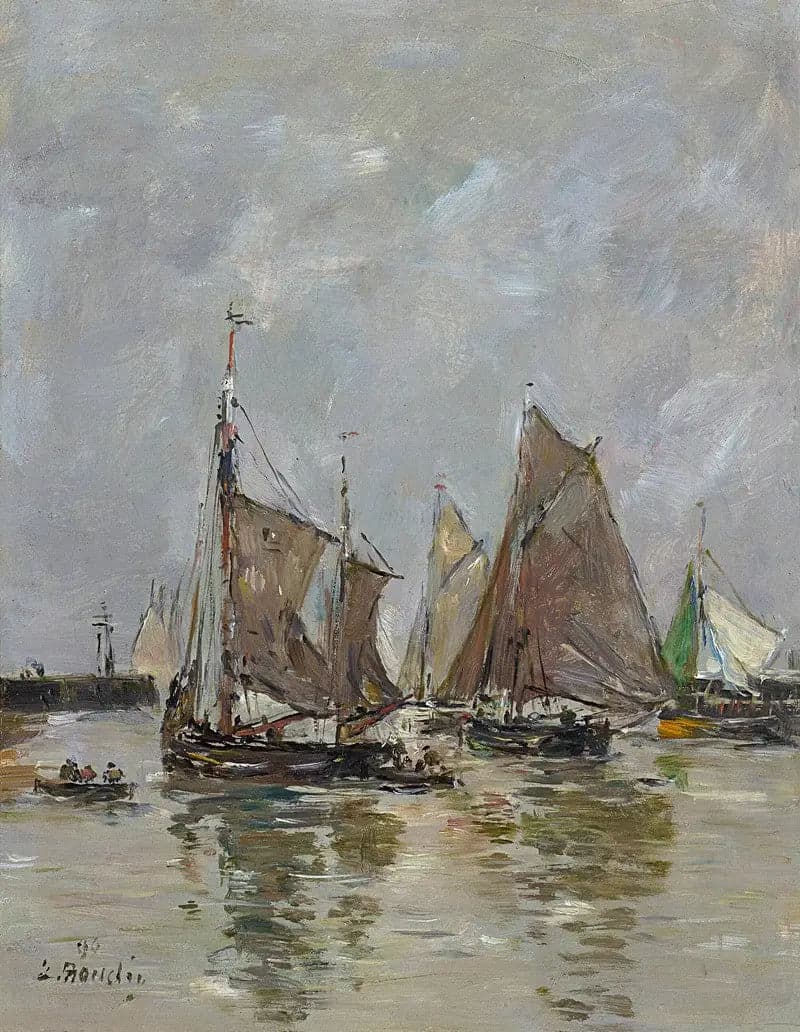
Trouville, the equipment of the sardine fishermen
- Original dimensions
- 21.2 x 27.1 cm
- Museum
- Not specified
- Year
- 1894
Scene depicted
The painting “Trouville, the Sardine Fishermen” offers a picturesque view of a community of fishermen in full activity. As the boats prepare to set sail, the pictorial work depicts a harmony between water and land, between man and nature. The silhouettes of the sardine fishermen stand out against a blue sky, while the waves gently caress the quays, evoking a suspended moment where every detail breathes serenity and labor.
Historical context
Created in 1894, this painting evokes the coastal town of Trouville-sur-Mer, a vibrant port in Normandy, famous for its fishing lines and lively atmosphere. A prominent member of the Impressionist movement, Eugène Boudin captures the essence of a time when sardine fishermen bustle on the quay, offering a window into maritime life at the end of the 19th century. This canvas , although part of the French cultural heritage, is not currently displayed in a museum, which enhances its rarity. Its delicate dimensions testify to the intimacy of a scene from daily life.
Place in the artist's career
This painting is situated at a pivotal moment in Eugène Boudin's career. By the end of the 1890s, the artist, known for his coastal landscapes and his ability to represent light, reaches a stylistic peak. Alongside works such as “The Port of Fécamp” and “The Beach of Trouville,” “Trouville, the Sardine Fishermen” illustrates Boudin's evolution towards a brighter and more nuanced approach to the canvas .
Anecdote
“Art is learning to see, to capture the fleeting moments that nature offers us.” It was while strolling on the beach of Trouville, on a gentle spring morning, that Boudin once wrote this phrase. The rays of the sun pierced the morning fog, and every cry of the seagulls seemed to inspire him. It is this precise moment that breathed life into this vibrant canvas , a symbol of the interaction between man and the sea.