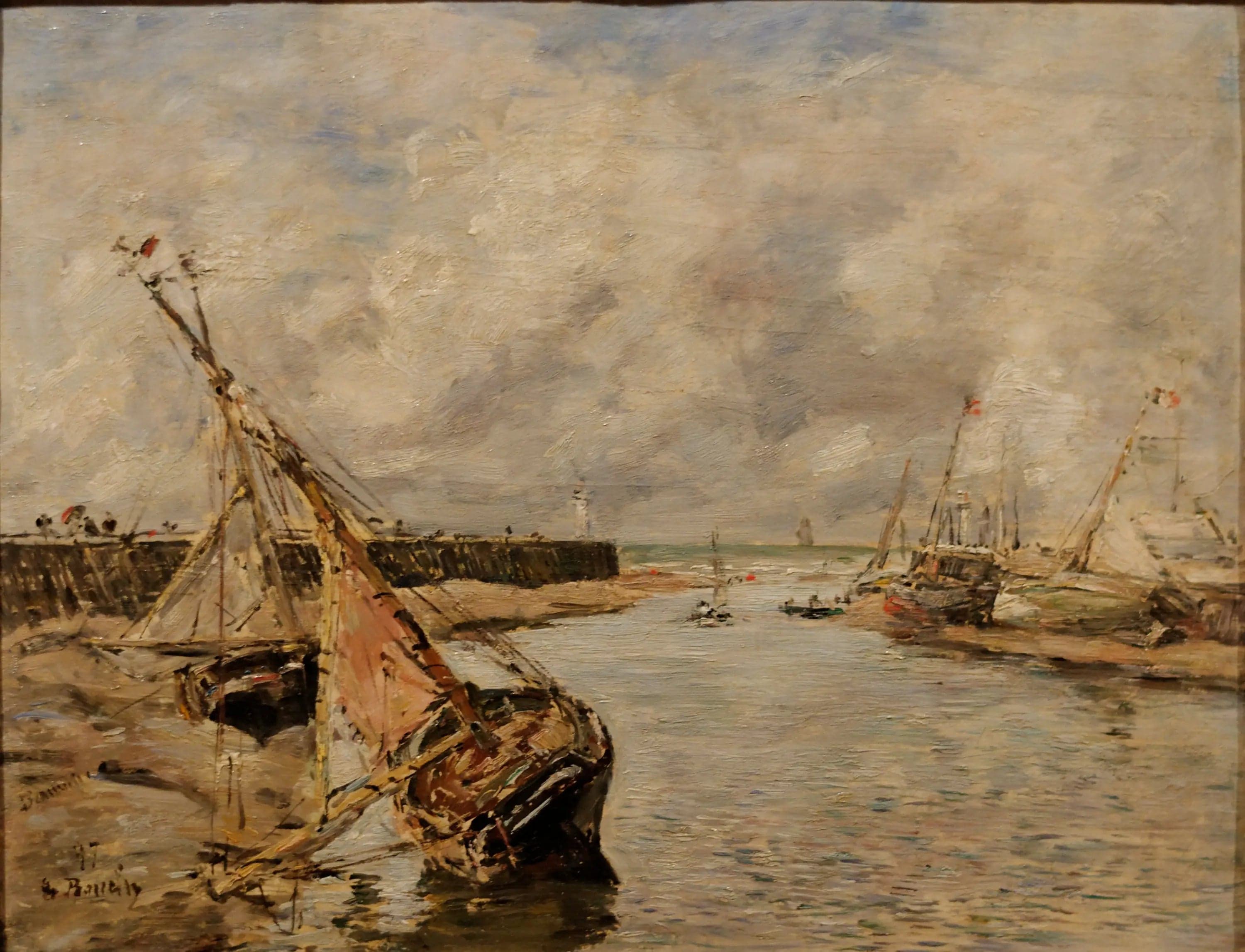
Trouville-Deauville – Low Tide
- Original dimensions
- 28 x 40 cm
- Museum
- Calouste-Gulbenkian Museum
- Year
- 1897
Scene depicted
In this pictorial work, Eugène Boudin depicts a low tide in Trouville, revealing the stranded boats and the silhouettes of bathers. The gaze gets lost in the subtleties of the Normandy coast, where every detail, from the reflections in the water to the play of shadows on the wet sand, tells a story of conviviality and the sweetness of life characteristic of that era.
Historical context
Created in 1897, this painting embodies its roots in Trouville, a popular French seaside resort, in the heart of Normandy. This canvas is part of the Impressionist movement, a revolutionary artistic movement that seeks to capture the fleeting impressions of light and color. Today, this precious canvas is preserved at the Calouste-Gulbenkian Museum , where its beauty continues to enchant visitors from around the world.
Place in the artist's career
Trouville-Deauville – Marée basse represents a significant milestone in Boudin's career, illustrating his mature style. Alongside other masterpieces such as "Les Plages de Trouville" and "Le Port de Honfleur," this painting testifies to his skill in capturing light and movement, revealing the evolution of his pictorial approach.
Anecdote
Eugène Boudin , famous for his keen eye on light, said: “Every sunrise is a new canvas that opens to our eyes.” One spring morning in 1897, as the gentle rays of the sun caressed the shores of Trouville, he immortalized himself in this scene, vibrant with life and emotion. His canvas evokes a stolen moment, an ephemeral encounter between the sea and the sky, a palpable serenity.