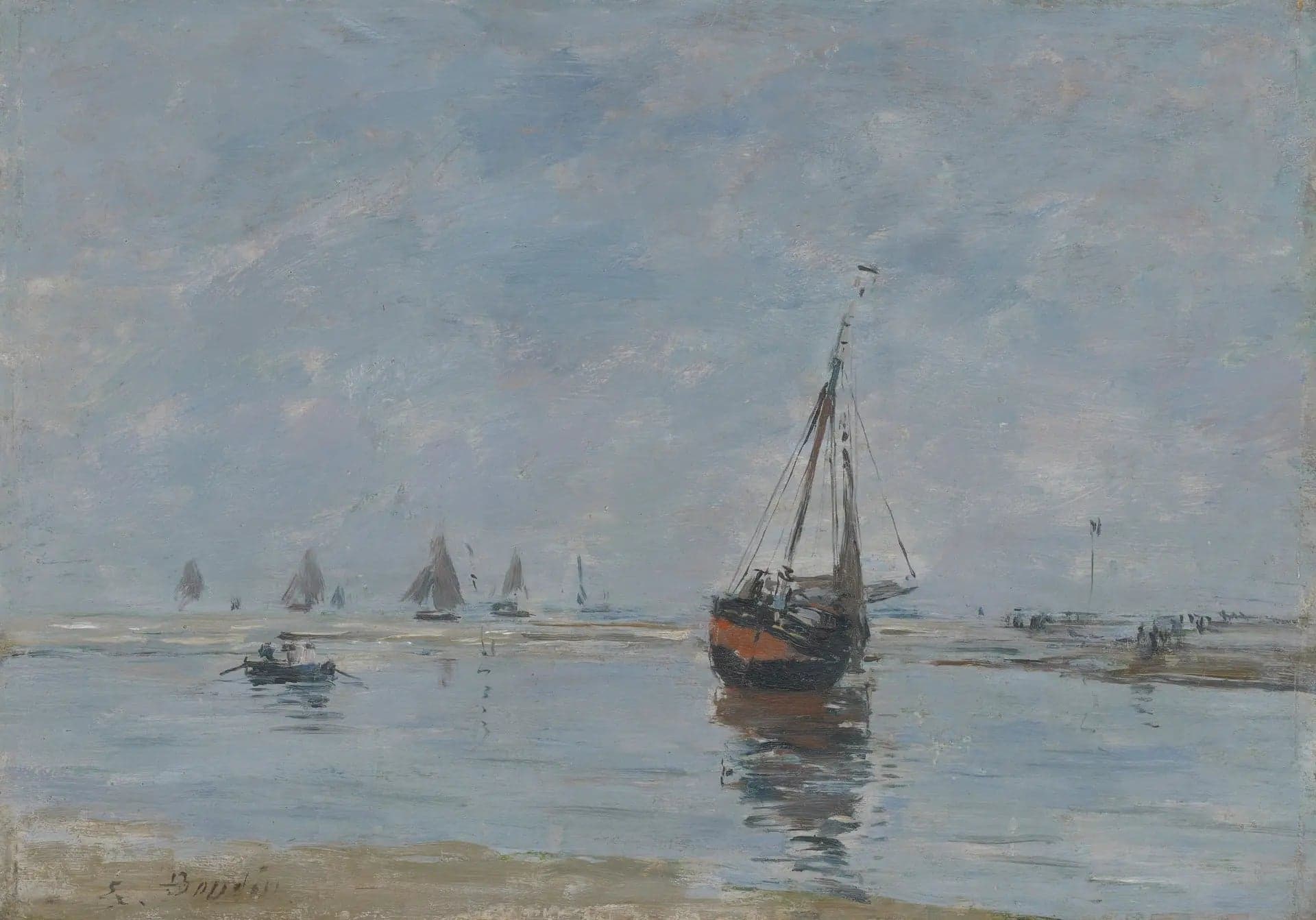
Trouville at low tide
- Original dimensions
- 31.4 x 21.9 cm
- Museum
- Yale University Art Gallery
- Year
- 1891
Scene depicted
The painting "Trouville at Low Tide" presents a striking encounter between the sea and the land, where the coastline reveals the secrets of the shores bathed in the golden light of the sun. The stranded boats, testifying to a temporary rest, confer an atmosphere of tranquility, while the low tide reveals mussels and shells, adding a touch of mystery to this soothing scene.
Historical context
Created in 1891, the painting "Trouville at Low Tide" is part of the Impressionist movement, brilliantly illustrating the charm of the Normandy coast in Trouville. Capturing the very essence of a falling tide, this canvas is currently displayed at the Yale University Art Gallery , where it testifies to a time when art and nature intertwined. With dimensions of 31.4 x 21.9 cm, this painting invites exploration of the delicate beauty of this locality.
Place in the artist's career
This painting represents a turning point in the career of Eugène Boudin , marking a period of great maturity. Compared to other paintings such as "La Plage de Trouville" and "Le Port de Honfleur," this work reveals a notable technical evolution. His innovative approach to light and captivating composition places Boudin among the masters of Impressionism .
Anecdote
“To paint is to live twice.” This quote from Boudin resonates with the evocative power of his masterpiece . It is a spring morning in Trouville, when the first light of day illuminates the sky, that the painting took shape. Inspired by the whisper of the waves and the salty scent of the sea, the artist managed to capture this unique atmosphere in "Trouville at Low Tide," making tangible the ephemeral beauty of coastal landscapes.