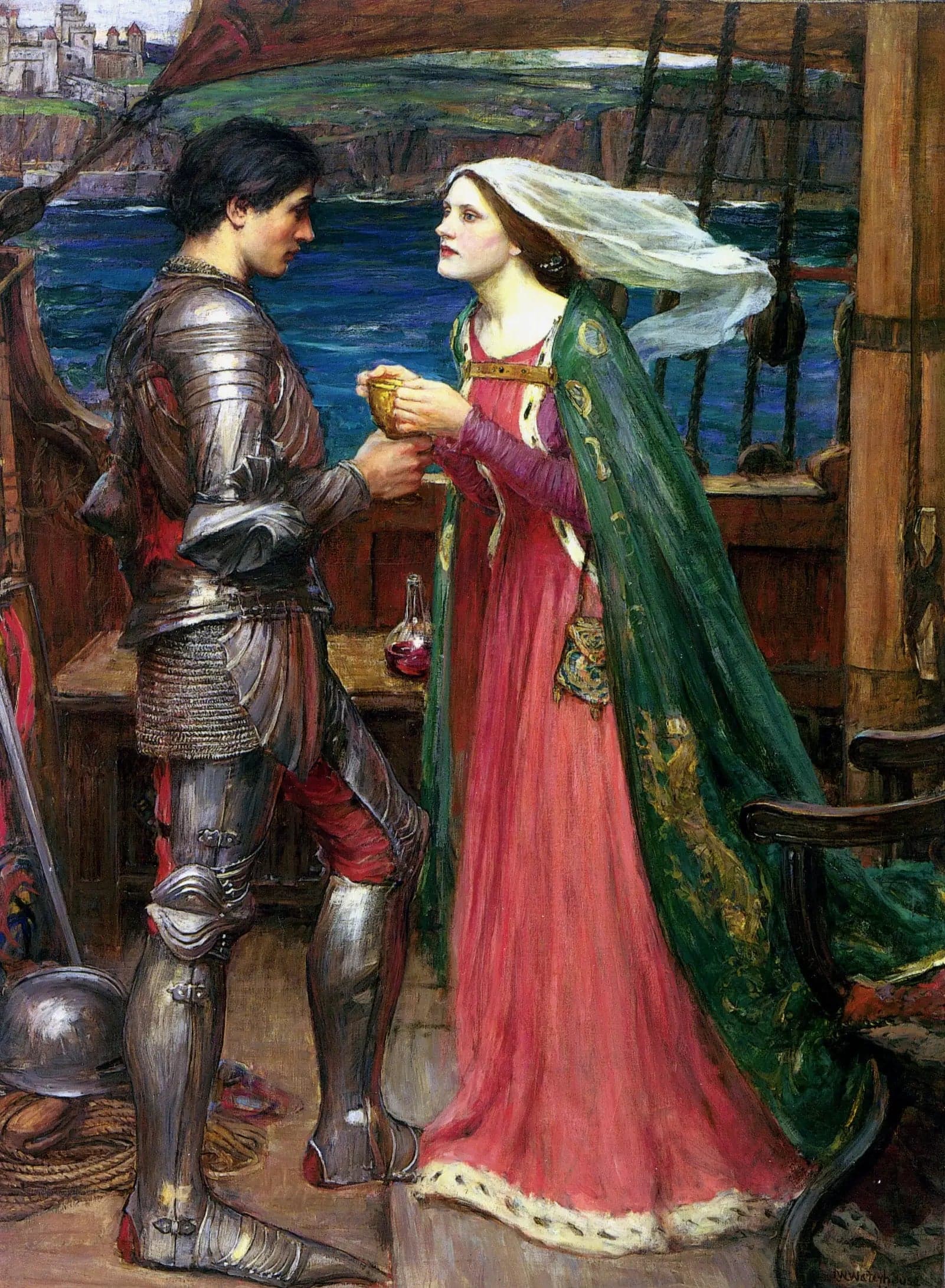
Tristan and Isolde with the Potion
Scene depicted
This painting mythically transports the viewer into the intimacy of a crucial moment: Isolde, an illuminated figure of fragile beauty, offers Tristan the love potion, echoing devastating passions. The exchanged glances, imbued with desire and fatality, capture the very essence of the myth, where love intertwines with tragedy.
Historical context
Created in 1916, the painting Tristan and Isolde with the potion finds its roots in London, at the heart of the Pre-Raphaelite movement. This period, marked by a desire to return to authenticity and medieval beauty, sublimates a tragic tale whose echo still resonates today. Currently, this canvas resides at the Tate Britain , a witness to an exceptional artistic heritage, measuring 61 x 91.4 cm.
Place in the artist's career
The painting Tristan and Isolde with the potion is situated at a turning point in Waterhouse's career, bearing the signature of an artist at the peak of his maturity and style. In parallel with Sleeping Beauty and The Sirens , two of his other canvases , one observes an evolution in the expression of feelings and the treatment of light: from gentle daydreaming to contained passion.
Anecdote
“Art is the reflection of our human passions, a mirror that everyone can look into and find their soul.” This quote, inspired by the very heart of John William Waterhouse , evokes a spring morning when the artist, gently strolling through the garden of his studio, would have encountered the vision of Tristan and Isolde, a duo of love and despair that whispered timeless secrets to him. Thus, each brushstroke on this canvas reveals a pure, vibrant emotion.