Trees
- Original dimensions
- 70.8 x 94 cm
- Museum
- Carnegie Museum of Art
- Year
- 1912
Scene depicted
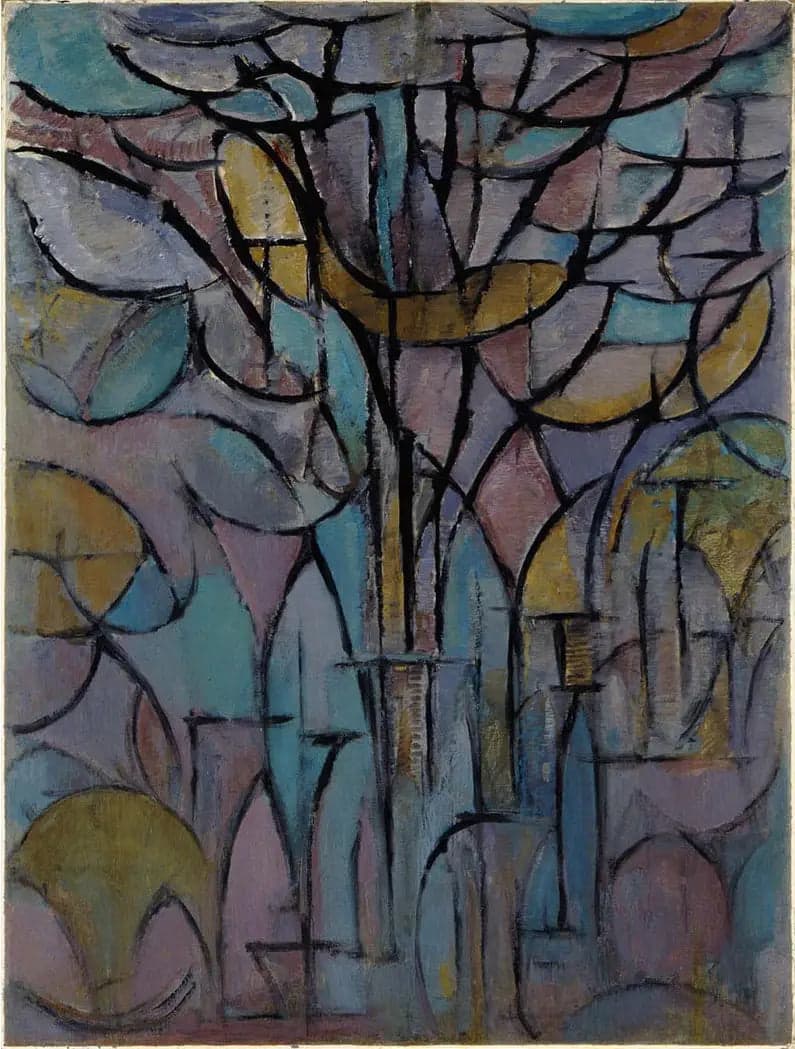
"Trees" is a pictorial work that illustrates the fusion of reality and abstraction. Mondrian uses geometric shapes to capture the essence of a forest, paying homage to natural beauty while inviting a deep meditation on the structure of life. Each brushstroke translates a heartbeat, a surge of life, revealing the thousand shades of a revealing landscape.
Historical context
Year: 1912 |BRK| Museum: Carnegie Museum of Art |BRK| Dimensions: 70.8 x 94 cm
Place in the artist's career
This painting , "Trees," is at a turning point in Mondrian's career. It is a prelude to his later works such as "Composition in Red, Yellow and Blue" and "Victory Boogie Woogie." With a style in full evolution, Mondrian draws from abstraction while maintaining a strong emotional connection to the natural world, contrasting with the more rigid canvases of his later phase.
Anecdote
Piet Mondrian is said to have stated: "Art is the mirror of life, it transcends mere representation." Inspired by the surrounding nature during a morning walk, he captured the fragile splendor of the trees, transforming an ephemeral moment into a masterpiece that is timeless. This painting vibrates with an energy, a particular light that evokes a communion between man and nature.