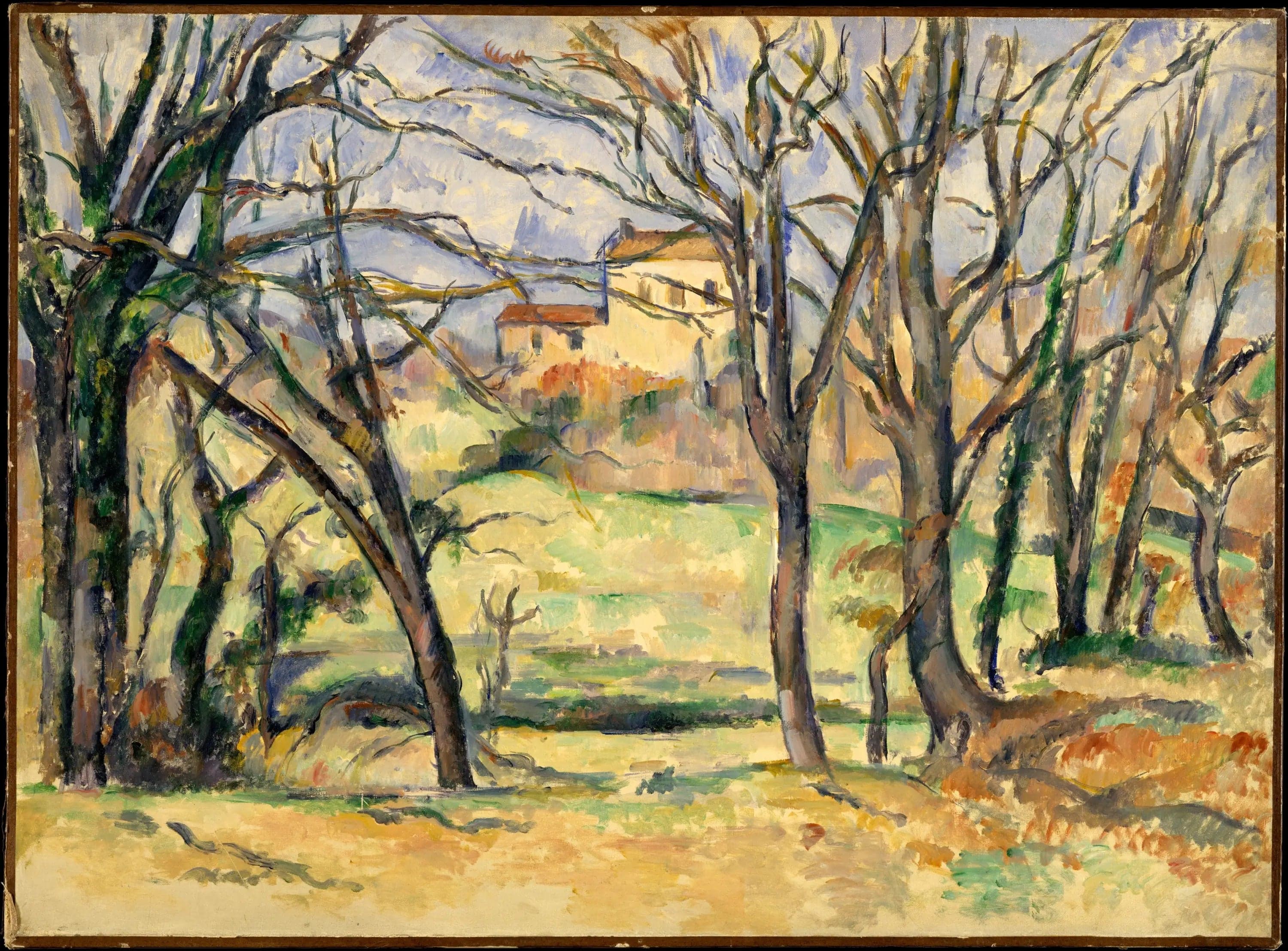
Trees and houses at the place called La Durane
- Original dimensions
- 73 x 54 cm
- Museum
- Orangerie Museum
- Year
- 1885
Scene depicted
This painting depicts a serene scene, where robust trees rise majestically, surrounding typical houses of the Provençal countryside. The thick trunks of the heroic trees form a striking contrast with the softness of the homes, suggesting a harmony between man and nature. Cézanne's brushstrokes convey an almost living movement, establishing a communion between the landscape and the soul.
Historical context
This painting emblematic was created in 1885, in the heart of Provence, a region rich in light and colors. Inscribed in the post-impressionist movement, Trees and Houses at the place called La Durane masterfully illustrates the artistic upheaval of its time. Today, the canvas is located at the Orangerie Museum , one of the temples of art in Paris, where its dimensions of 73 x 54 cm attract all eyes.
Place in the artist's career
Trees and Houses at the place called La Durane finds its place in Cézanne's career as a significant turning point towards a more mature expression. Compared to works like The Montagne Sainte-Victoire and The Card Players , one observes here a technical evolution, reflecting a dialogue between volume and color, a reflection of a constant search for harmony.
Anecdote
“Nature is my palette, my emotions are its colors.” These words resonate like a melody in the mind of one who often retreated to the fields of Provence to soak in its beauty. Imagine Cézanne, one spring morning, observing the dance of shadows on the hills, his painting coming to life before his eyes. A pure inspiration, a vibration, that echoes in the evocative power of Trees and Houses at the place called La Durane .
Major exhibitions
From Corot to Modern Art. Memories and Variations