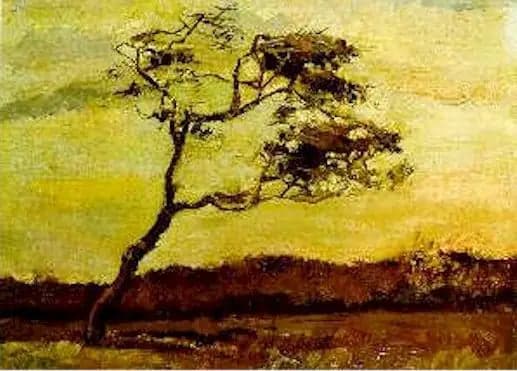
Tree whipped by the wind
- Original dimensions
- 47 x 35 cm
- Movement
- realism
- Museum
- Not specified
- Year
- 1883
Scene depicted
In this pictorial work, a majestic tree stands, terribly shaken by the wind, symbolizing the struggle between raw nature and fragile beauty. The torments and roughness of the landscape blend with a sound atmosphere, almost palpable, where the rustling of leaves evokes a dialogue between the tree and the anxiety of the sky. It is a suspended moment, where every detail of the scene allows us to grasp the elemental force of nature.
Historical context
This painting captivates and was created in The Hague, a city where the artist found inspiration at the end of the 19th century, during the height of the realistic movement. Van Gogh, with his unique perspective, highlighted the tumultuous nature surrounding him. The painting, like a visual poem, evokes a carnal moment of nature, frozen in a breath of wind, a moment that speaks of the deep connection between man and his environment.
Place in the artist's career
Whipped Tree by the Wind marks a significant step in Van Gogh's career, before his stylistic flight towards more vibrant works. This painting fits into a broader context, alongside his famous canvases like The Starry Night and The Sunflowers , highlighting his technical evolution, oscillating between emotional turbulence and chromatic harmony. A true reflection of his tormented spirit yet always in search of beauty.
Anecdote
Vincent van Gogh , passionate about nature, once said: "Nature is my greatest muse, it speaks to me in every rustle of leaves, every breath of wind." The genesis of Whipped Tree by the Wind emerged one spring morning, where, wandering the streets of The Hague, he contemplated a tree swaying vigorously, his mind vibrating with raw emotion. This vision transformed into a masterpiece and testifies to the evocative power of the canvas .