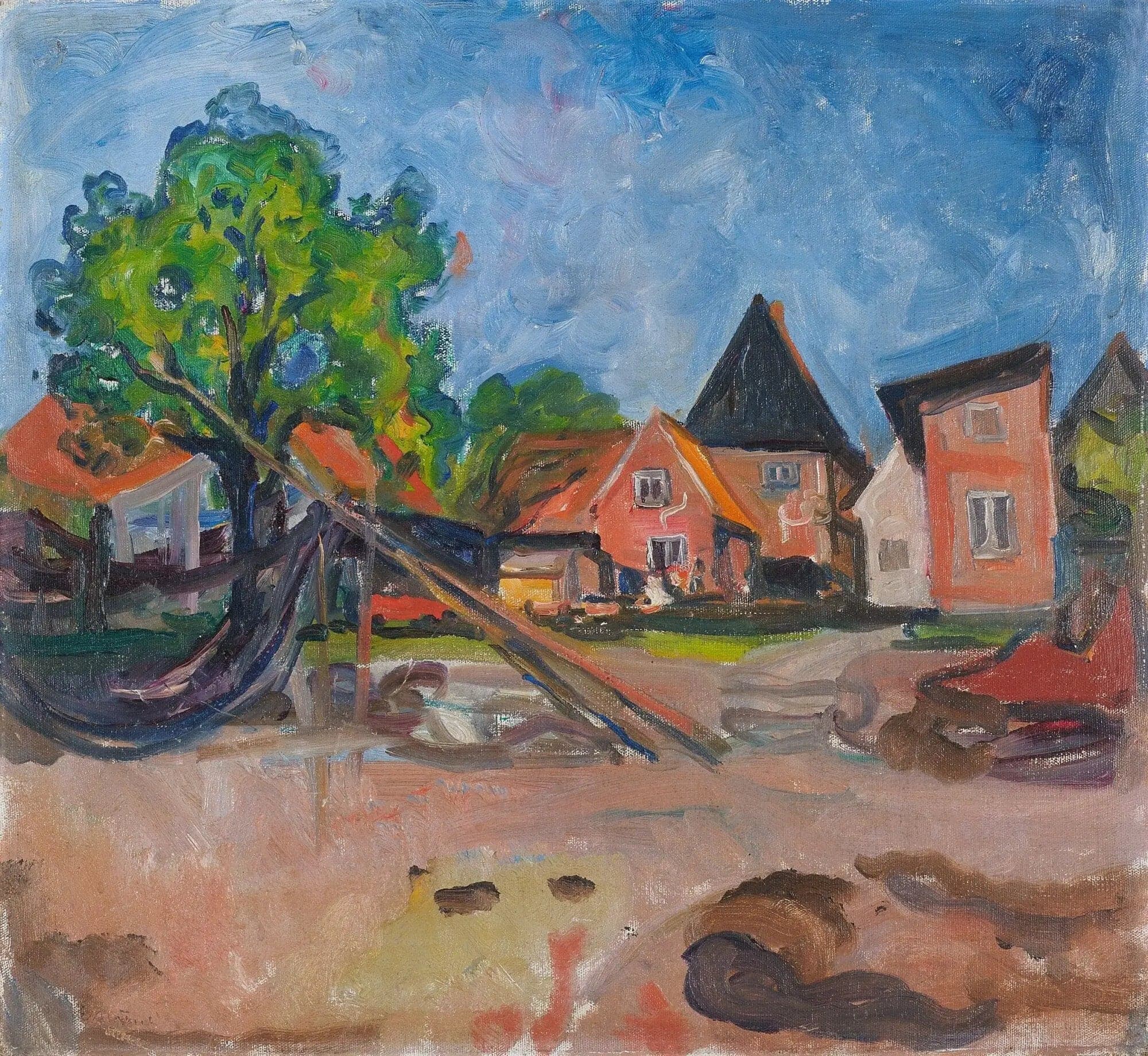
Travemünde
- Original dimensions
- 70 x 65 cm
- Museum
- Museum Behnhaus Drägerhaus
- Year
- 1903
Scene depicted
The painting "Travemünde" captures a serene atmosphere, where gentle waves fade onto the golden sand and where the azure hues of the water meet the sky. Through a delicate and harmoniously balanced composition, Munch depicts a moment suspended in time, an invitation to feel the peace of a place where nature and man merge. The safety of the shore and the movement of the water translate into a duality of emotions, oscillating between tranquility and introspection.
Historical context
Created in 1903, the painting "Travemünde" by Edvard Munch finds its roots in the charming seaside town of Travemünde, located on the coast of the Baltic Sea, in Schleswig-Holstein. This canvas is emblematic of the expressionist movement that characterizes the era, offering a personal and intuitive vision of a seascape that is both soothing and melancholic. Currently, this painting is displayed at the prestigious Museum Behnhaus Drägerhaus, where it continues to enchant with its depth and delicate sensitivity.
Place in the artist's career
"Travemünde" marks a significant milestone in the career of Edvard Munch , situated between his promising beginnings and the recognition that would follow with masterpieces such as "The Scream" and "The Madonna." In this painting , we already find the mastery of forms and the ability to express a complex emotional palette. It allows us to follow the innovative evolution of an artist in search of authenticity and truth in his paintings , while remaining anchored in his own artistic reality.
Anecdote
Edvard Munch once stated: "Art must be a cry, a dream, a truth." On the shore of a spring morning, the gentle sound of the waves and the salty scent of the air inspired this pictorial work , an introspective look at the harmony and empathy that nature evokes in us. This moment of grace is deeply rooted in the evocative power of "Travemünde," revealing the hidden emotions behind each brushstroke.