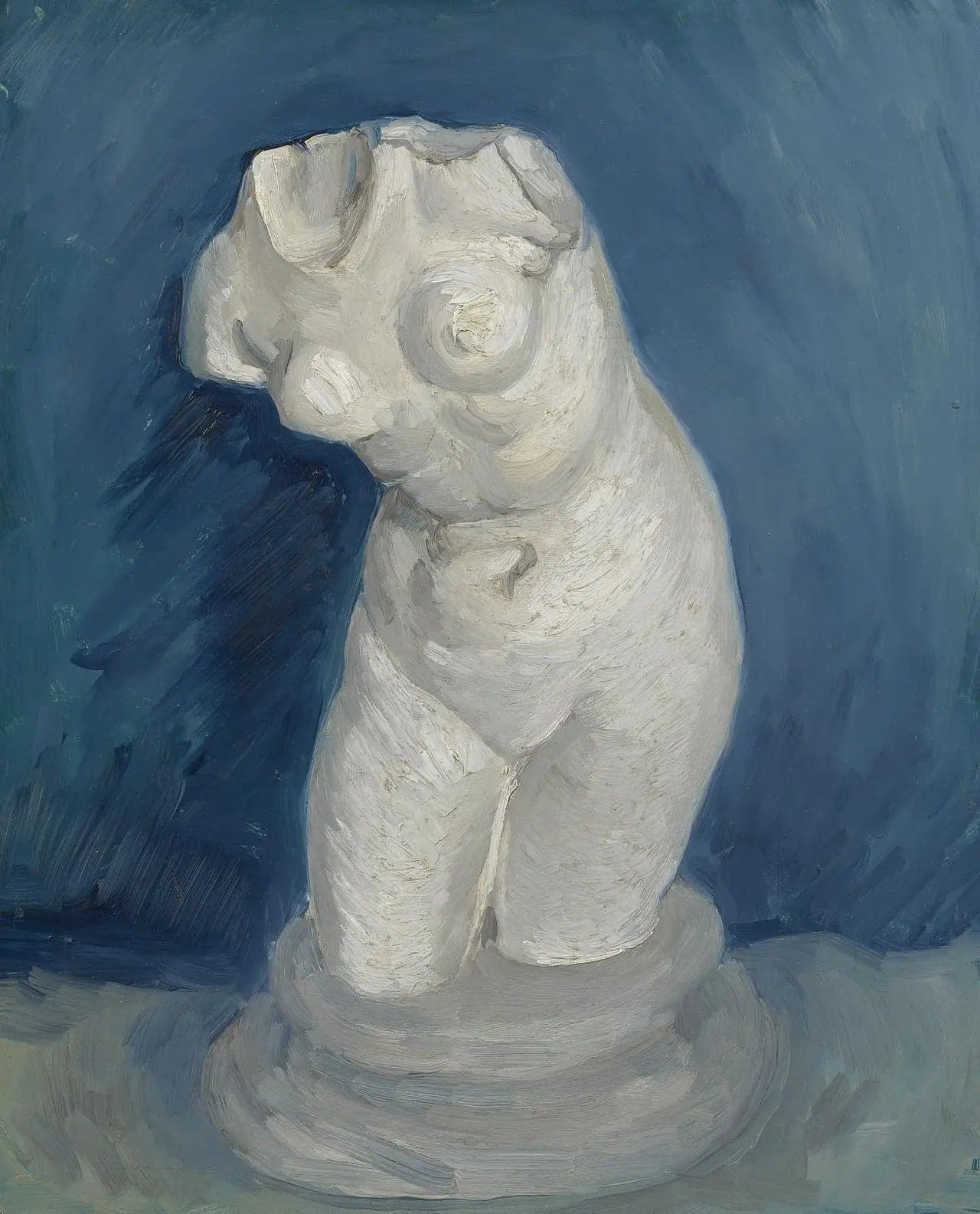
Torso of Venus
Scene depicted
The painting “Torse de Vénus” immerses us in a stylized representation of a female figure, embodying both beauty and vulnerability. Vincent, through his bold approach, manages to evoke a mythological allure, where the torso becomes both an object of admiration and contemplation. It is an ode to beauty, a dialogue between the artist and his subject, paying homage to classical aesthetics.
Historical context
Created in 1886, in the vibrant heart of Paris , this painting marks a crucial step in the work of Vincent van Gogh , who was then in the midst of learning painting techniques. The canvas original is now located at the Van Gogh Museum , where it is preserved and admired by art enthusiasts from around the world. With captivating dimensions of 38 x 47 cm, this work is emblematic of post-impressionism , reflecting an era focused on pure emotion.
Place in the artist's career
This canvas fits into a formative period of the artist. Far from being his only masterpiece , it stands alongside “ The Potato Eaters ” and “ Starry Night ”, illustrating a creative evolution towards a bolder and more expressive style, thus revealing the emotional depth of his artistic journey.
Anecdote
Vincent once confided: “The painting is a poetry that can be seen.” This sentiment inspired him during the creation of this masterpiece , capturing the essence of timeless beauty. Inspired by the light of a spring morning, Vincent sought to translate the delicate nuances of a female torso, aiming to immortalize a fleeting grace in his canvas .