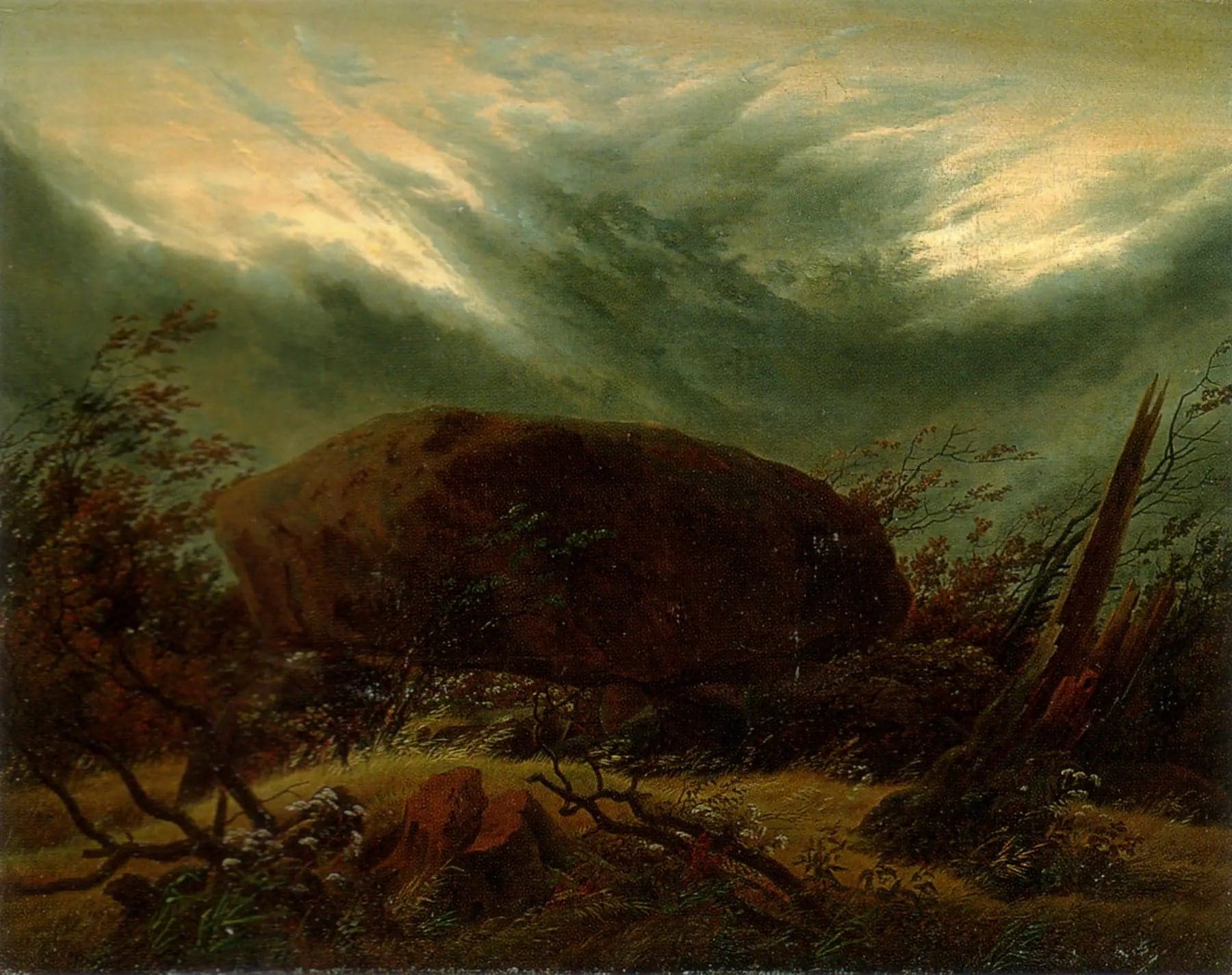
Tomb of the Hun in Autumn
- Original dimensions
- 71 x 55 cm
- Movement
- romanticism
- Museum
- Galerie Neue Meister
- Year
- 1820
Scene depicted
This painting traces the winding path leading to an ancient tomb, where the omnipresent nature asserts its majesty. The trees with golden leaves stand as silent guardians. The serene atmosphere evokes a melancholic feeling, a tribute to those who have passed, but whose memory remains vivid through the cycle of the seasons.
Historical context
Artwork: Tomb of the Huns in Autumn |BRK| Artist: Caspar David Friedrich |BRK| Year: 1820 |BRK| Museum: Galerie Neue Meister |BRK| Dimensions: 71 x 55 cm |BRK| Artistic Movement: romanticism |BRK| Major Exhibitions: Dahl and Friedrich. Romantic Landscapes |BRK|
Place in the artist's career
Tomb of the Huns in Autumn represents a culminating statue in Friedrich's career, reflecting his artistic evolution alongside other works such as Wanderer above the Sea of Fog and The Sea of Ice . This painting embodies both his technical mastery and his introspective exploration of natural and spiritual landscapes.
Anecdote
“Nature speaks to me of buried secrets,” Friedrich is said to have declared one day, inspired by the melancholic landscapes he contemplated in the autumn mist. This moment of clarity is reflected in the enchanting canvas of Tomb of the Huns in Autumn, a work of profound emotional resonance.
Major exhibitions
Dahl and Friedrich. Romantic Landscapes