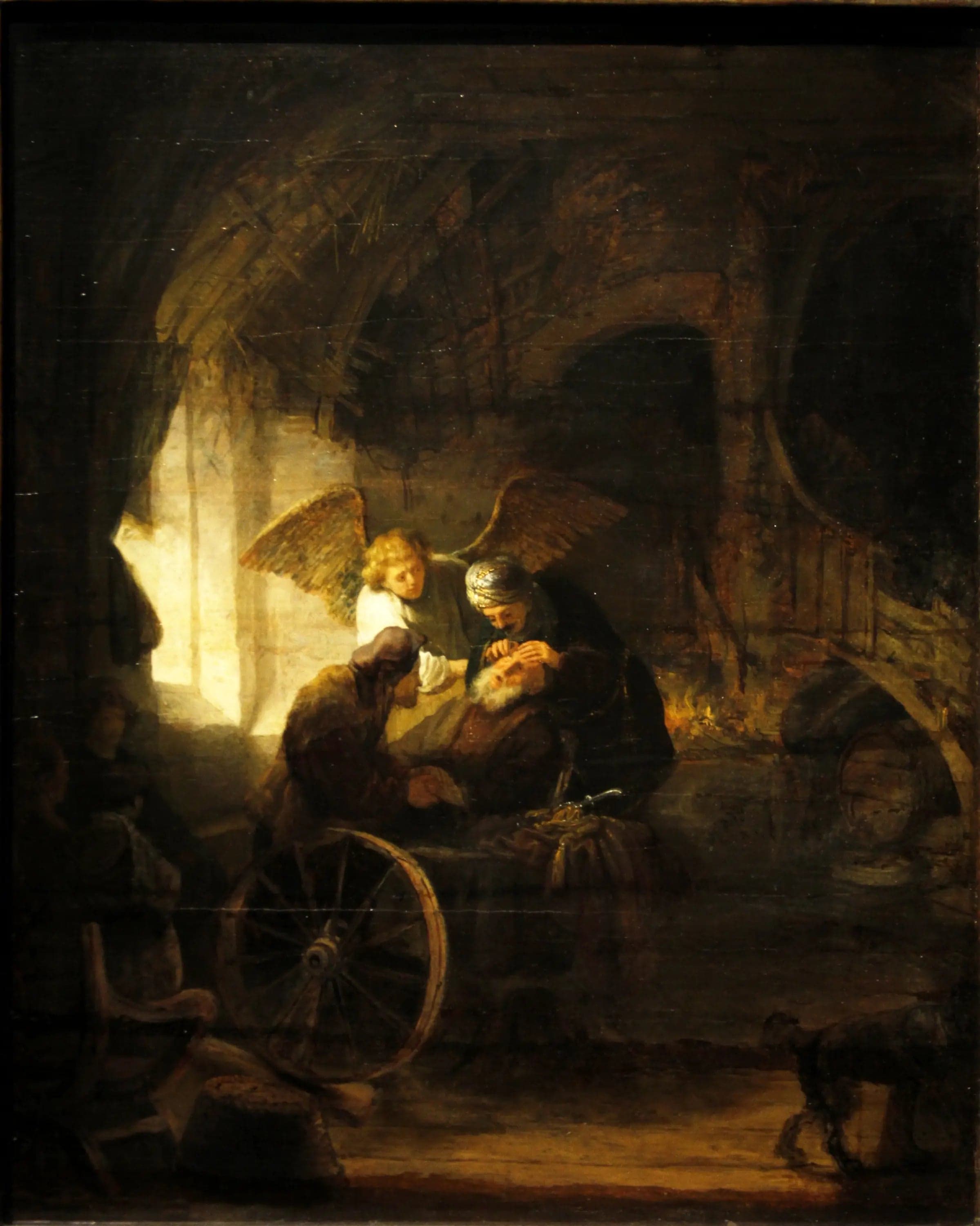
Tobias heals his blind father
- Original dimensions
- 38.8 x 47.2 cm
- Museum
- Staatsgalerie Stuttgart
- Year
- 1636
Scene depicted
This painting depicts a poignant scene where Tobias, a young man with a compassionate face, heals his blind father, Tobit. This composition unfolds in an atmosphere filled with intimacy and tenderness, symbolizing the power of familial bonds and the hope for a bright future. The delicate gestures illustrate the son's tenderness towards his father, a moment suspended between spirituality and humanity.
Historical context
Created in 1636, this painting is emblematic of the depths of the Dutch golden age in Amsterdam. Rembrandt , known for his skill in capturing human emotions, dives into a universe rich in chiaroscuro, characteristic of the baroque movement. Currently housed at the Staatsgalerie in Stuttgart, this canvas vibrant with life and pain promises to inspire any soul daring enough to approach it.
Place in the artist's career
In the career of Rembrandt , Tobias heals his blind father represents a turning point, going beyond simple portraits of the bourgeoisie to explore inner emotional landscapes. His famous paintings such as "The Night Watch" and "The Return of the Prodigal Son" also testify to a meeting between light and shadow, establishing a fascinating evolution of his mastery of painting.
Anecdote
Rembrandt once confided: "Light reveals the soul of a man." It was in a sunlit alley in Amsterdam, one spring morning, that he drew his inspiration for this canvas . The diffused brightness of the early rays of the day reflects in Tobias's eyes, a glimmer of grace that gives an evocative strength to this pictorial work .