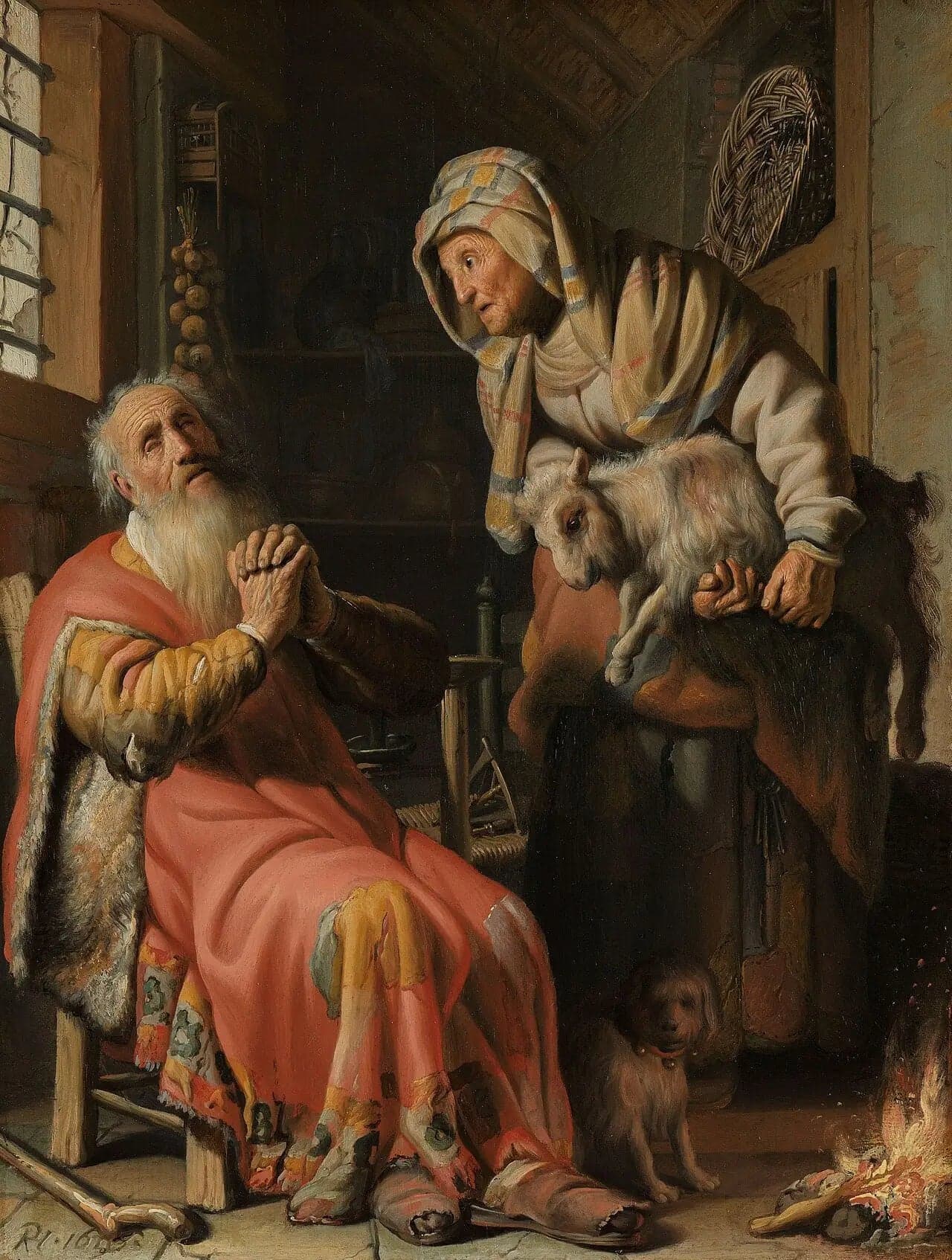
Tobias and Anna with a Little Goat
- Original dimensions
- 30 x 39.5 cm
- Movement
- Dutch Golden Age
- Museum
- Rijksmuseum
- Year
- 1626
Scene depicted
The canvas highlights a touching scene from the Bible, where young Tobias stands beside his mother, Anna, holding a small goat. This moment symbolizes both a quest for values and the unbreakable bond between mother and son, tenderly illustrating the innocence of childhood and the sweetness of home. The viewer, through the magic of painting , is invited to feel this family harmony that transcends time.
Historical context
Created in 1626, this painting is a striking example of the Dutch Golden Age. Set in the sumptuous surroundings of Amsterdam, the canvas by Rembrandt evokes a time when pictorial art reached technical and emotional heights. Today, this work is part of the precious collections of the Rijksmuseum , like a star in the sky of a flourishing culture.
Place in the artist's career
Tobias and Anna with a small goat represents one of the early phases of Rembrandt 's career, already testifying to his early genius. This precious work is part of a period of artistic maturity, where he explores the nuances of shadow and light. When compared to The Night Watch and The Anatomy Lesson of Dr. Tulp , one observes a fascinating evolution towards bolder and more narrative compositions, enriched by a progressive mastery of light.
Anecdote
Rembrandt is said to have once said: “Light is my muse, and I invite it to dance on every canvas.” It is in this luminous quest that he composed Tobias and Anna with a small goat . Imagine a radiant morning, where soft light filters through the drapes of a studio, the artist transcribes the brilliance of life with infinite delicacy, blowing a breeze of nostalgia over this canvas .