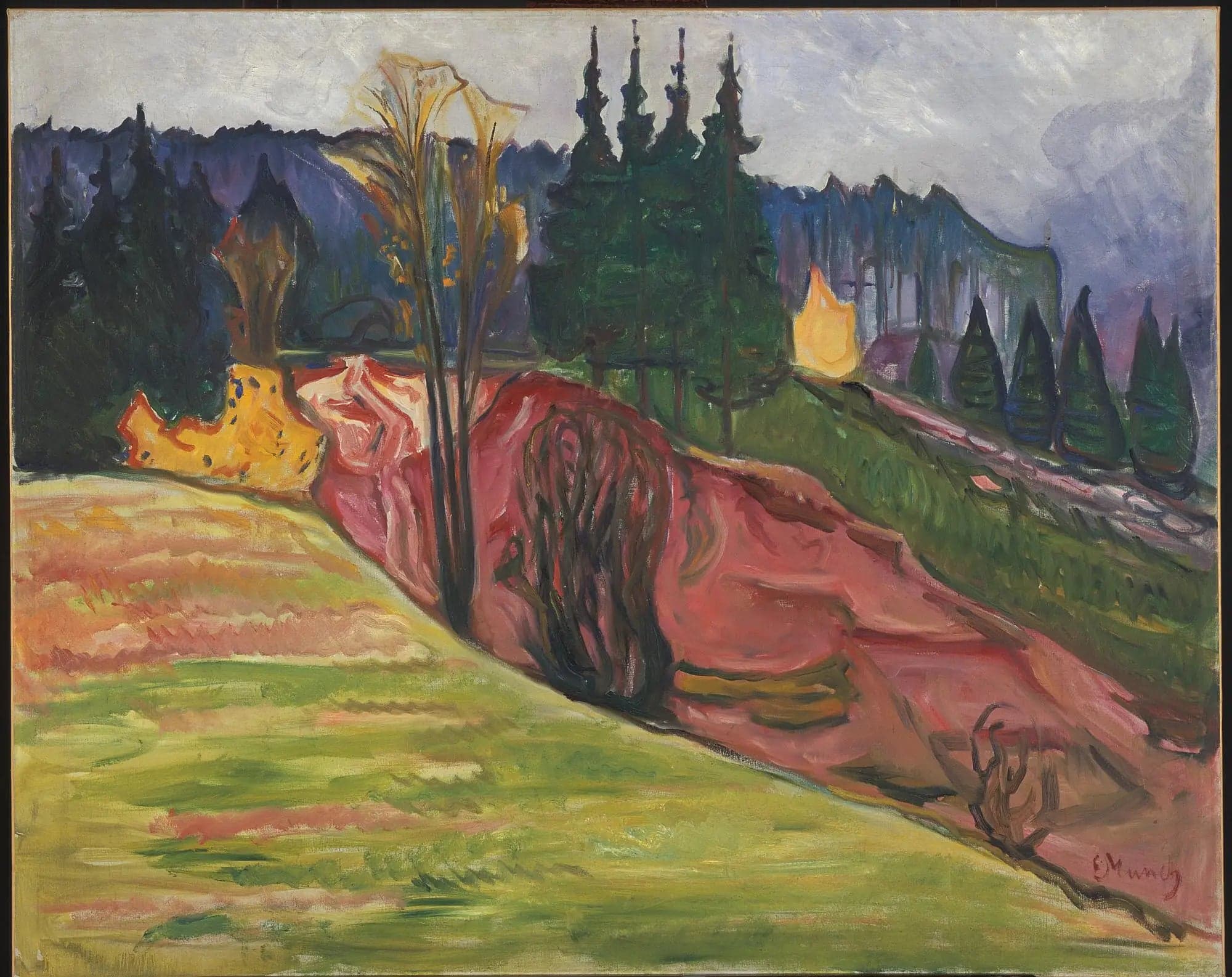
Thuringian Forest
- Original dimensions
- 100.33 x 75.57 cm
- Museum
- Dallas Museum of Art
- Year
- 1904
Scene depicted
The painting "Thuringian Forest" illustrates a majestic forest enveloped in mist, a place imbued with mystery. The trees, reaching towards the sky, seem to whisper ancient secrets, while the ground is cushioned with soft moss that testifies to the serenity of this natural space. The play of light and shadow contributes to creating an almost dreamlike atmosphere, where the viewer can lose themselves in thought.
Historical context
Created in 1904, this painting is rooted in Thuringia, a region of Germany often celebrated for its natural beauty. At this pivotal time, Edvard Munch is evolving within the Symbolist movement, where the depth of emotions and nature are predominant themes. The canvas is currently displayed at the Dallas Museum of Art , where its intimate atmosphere tirelessly attracts admirers.
Place in the artist's career
This painting marks a turning point in Munch's career, illustrating his ability to handle emotion through natural landscapes. Alongside famous works such as "The Scream" and "Madonna," "Thuringian Forest" reveals the artist's transition to stylistic maturity, a deep connection with nature, and a continual quest for the human soul.
Anecdote
Munch once confided: "Nature is a mysterious book where every tree tells a story." This phrase well summarizes the moment he settled in the forest, inspired by the soft morning light filtering through the foliage, and where he let his brush dance on the canvas capturing the volatile essence of the place.