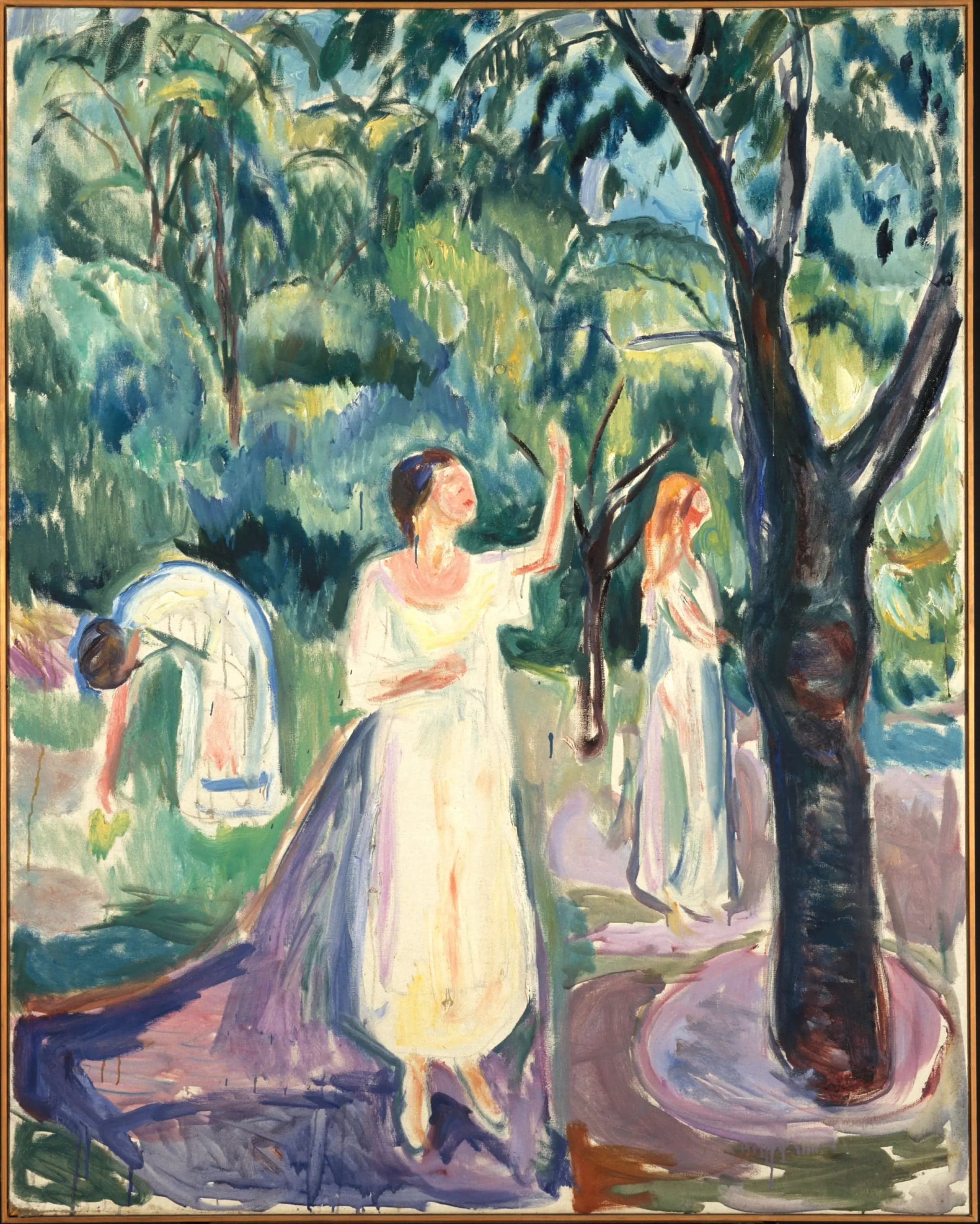
Three Women in the Garden
- Original dimensions
- 120 x 150.5 cm
- Museum
- Munch Museum
- Year
- 1926
Scene depicted
In the painting “Trois Femmes au jardin,” Munch depicts a scene imbued with serenity. Three female figures move gracefully, enveloped by the lushness of a flowering garden. The gestures, both tender and curious, suggest a communion with the surrounding nature, a search for beauty and harmony in the face of life's effervescence. This composition, both intimate and vast, invites deep contemplation.
Historical context
Created in 1926 and currently exhibited at the Munch Museum in Oslo, this painting is emblematic of the expressionist movement. Edvard Munch , in a period of creativity, explores here the themes of nature, human relationships, and pure emotion. The canvas, of impressive scale, embodies the vibrant landscapes of Norway, enveloped in soft and shimmering light.
Place in the artist's career
“Trois Femmes au jardin” represents a key stage in the career of Edvard Munch . Evolving beyond the dark themes of his beginnings, this masterpiece testifies to his artistic maturity. Alongside “The Scream” and “The Madonna,” this canvas explores a softer and more introspective impression, revealing the artist's evolution in his quest for emotional truth.
Anecdote
“In the garden, life reveals itself in ephemeral forms, silent exchanges between man and nature.” One spring morning, as the light caresses the leaves, Munch captures the fleeting moment where three women seem to bloom under the Norwegian sky. This canvas comes alive with delicate poetry, revealing the evocative power of the work.
Major exhibitions
Munch og Ekely: 1916-1944