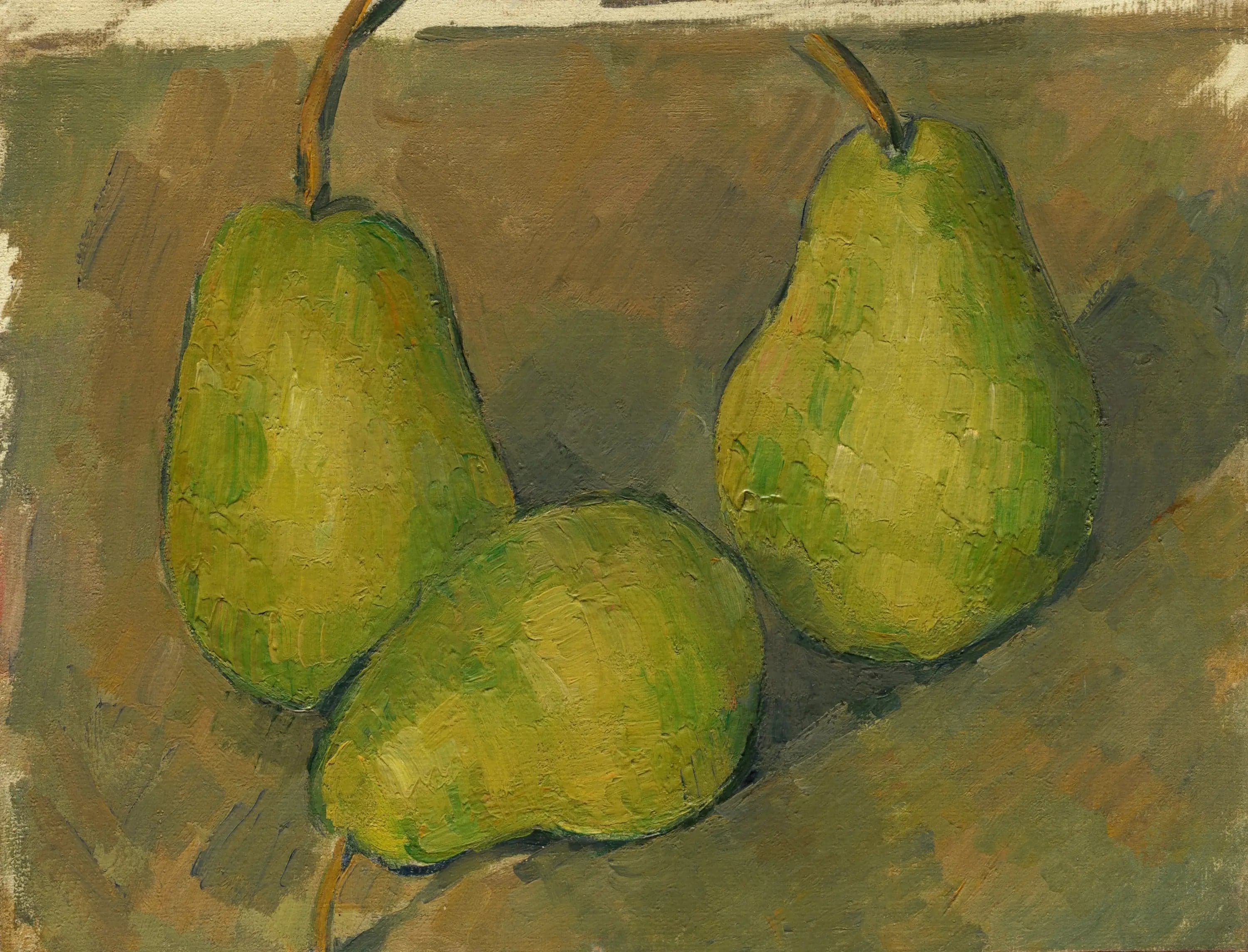
Three Pears
- Original dimensions
- 25.7 x 20 cm
- Museum
- National Gallery of Art
- Year
- 1878
Scene depicted
In this painting , three pears delicately placed echo a refined simplicity. Cézanne's harmonious composition evokes a moment suspended in time, a still life where each fruit stands as a static hero, illuminated by a soft, golden light. The canvas thus tells a story of life, a silent dialogue between these natural elements and the observer.
Historical context
Artwork: Three Pears |BRK| Artist: Paul Cézanne |BRK| Year: 1878 |BRK| Museum: National Gallery of Art |BRK| Dimensions: 25.7 x 20 cm |BRK|
Place in the artist's career
“Three Pears” marks a crucial step in Cézanne's career, testifying to his ascent to the pinnacle of post-impressionism . This masterpiece is situated between two other iconic works, “The Large Bathers” and “Mont Sainte-Victoire,” illustrating his technical evolution and the refinement of his pictorial approach. This period resonates with echoes of growing maturity.
Anecdote
“Nature is not just beautiful. It must be challenged!” one day declared Cézanne as he contemplated golden pears on the table of a sunny morning. This revelation in his studio, bathed in light, was the spark that led to the creation of this masterpiece. Through painting , he managed to capture not only the object but also the emotion that each fruit evoked.