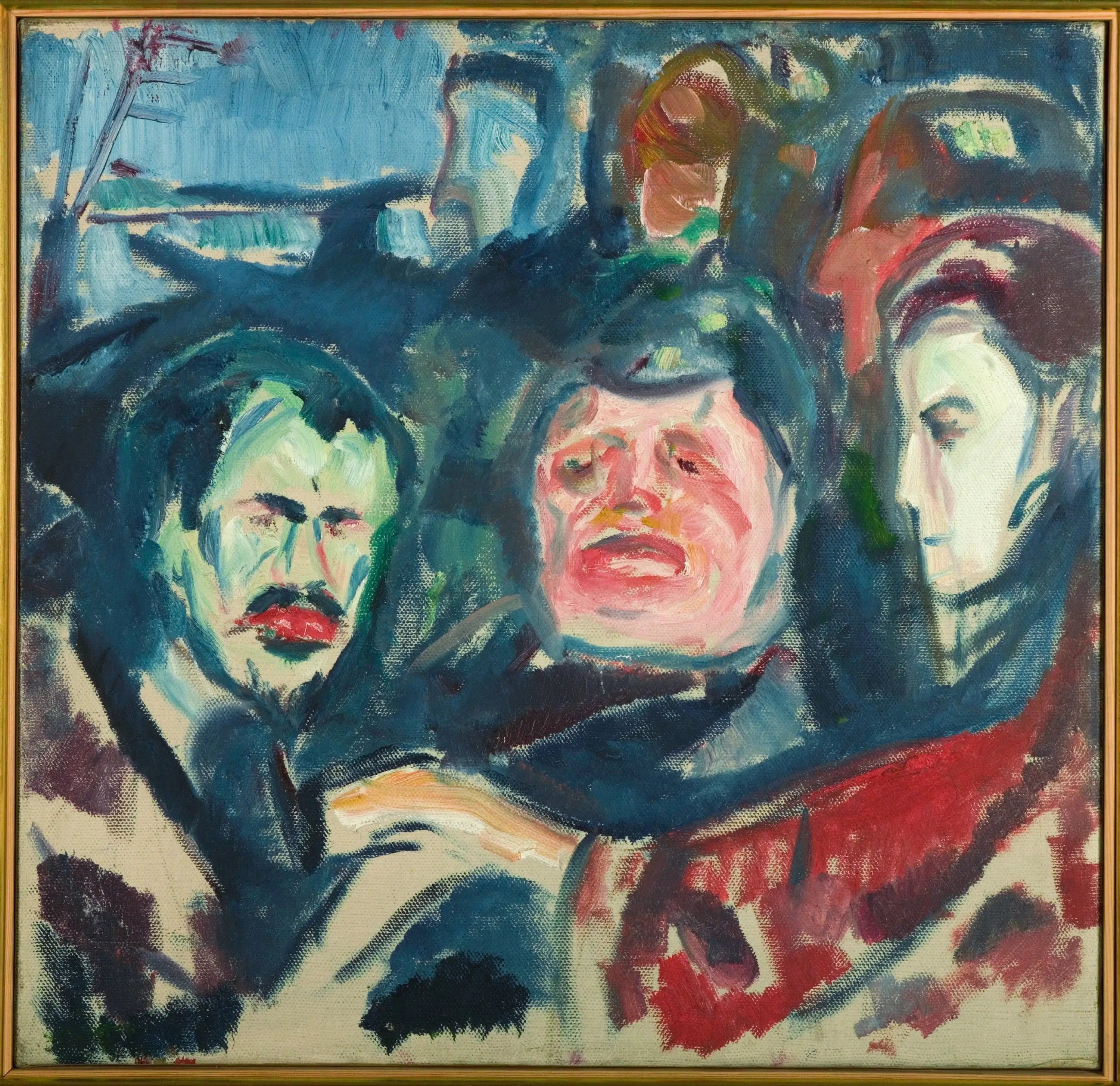
Three Men
- Original dimensions
- 60.5 x 58 cm
- Museum
- Munch Museum
- Year
- 1927
Scene depicted
The painting "Trois Hommes" depicts three silhouettes of men, evoking conflicting emotions of unity and isolation. In a setting with dark and intense tones, these figures seem to coexist while being separated by their own inner world. The silent interaction between them raises questions about the human condition and society, scrutinizing the complexities of male relationships and personal struggles.
Historical context
Created in vibrant Oslo, in the heart of Norway, in 1927, the painting "Trois Hommes" is part of the expressionist movement that had a lasting impact on modern art. It is in this effervescent cultural context that Munch, influenced by his own emotional and psychological experiences, produced this iconic canvas . Currently, this painting is located at the Munch Museum, a sanctuary dedicated to his work, where it is displayed alongside other masterpieces that have marked the history of art.
Place in the artist's career
The painting "Trois Hommes" is one of the key milestones in Munch's career, illustrating a period of artistic maturity, following his famous works like "The Scream" and "The Madonna." This canvas bears witness to a style that evolves towards a deeper exploration of emotions, revealing a capacity to capture psychological states through increasingly complex compositions.
Anecdote
"Every face carries a story, every gaze, a melancholy," Munch might have said when evoking his vision of the three figures in this masterpiece . Inspired by a morning autumn walk, he captured the essence of humanity and resonant solitude through this canvas . Thus, the painting becomes a reflection of the most intimate feelings, capturing the viewer's gaze.
Major exhibitions
Munch og Warnemünde: 1907-1908