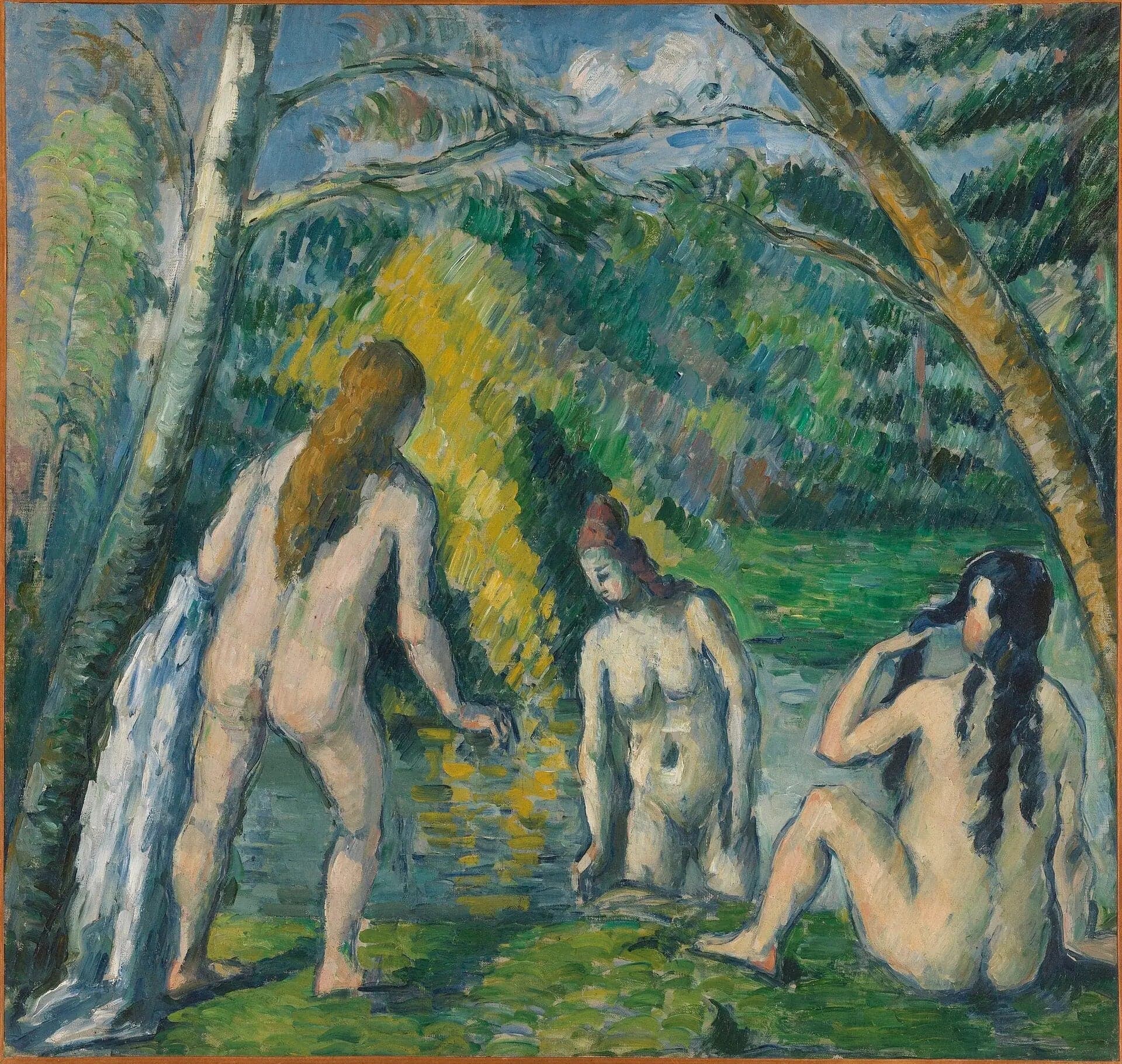
Three Bathers
- Original dimensions
- 70 x 67 cm
- Museum
- Petit Palais
- Year
- 1879
Scene depicted
On this canvas , Cézanne immortalizes three female silhouettes bathed in light, playing with water and shadows. The bathers, enigmatic figures, seem to dance in vibrant harmony, awakening in us an invitation to reconnect with nature. Each brushstroke evokes the softness of summer, as well as the intimacy of the shared moment, revealing Cézanne's mastery in painting emotions.
Historical context
Created in a vibrant and bustling Paris, Three Bathers is part of the post-impressionist movement, as Cézanne seeks to explore light and structure within his painting . This canvas , now displayed at the Petit Palais , evokes human relationships and nature, revealing a world imbued with calm and beauty. This painting also reflects a time when art began to free itself from academic constraints, propelling Cézanne towards recognition.
Place in the artist's career
Three Bathers represents a turning point in the career of Paul Cézanne , reflecting an artistic maturity. While he invokes the style of the impressionists in The Bridge of the Arc , his painting takes on a new dimension here, where the forms become stylized. This canvas gracefully positions itself between The Mountain Sainte-Victoire , emblematic of his search for structure, and The Card Players , a masterpiece of human relationships, signifying the culmination of his pictorial exploration.
Anecdote
“Beauty is a promise of happiness,” said Cézanne. One sunny morning, the artist strolls along the river, observing the serenity of the bathers. In this silence broken by the song of birds, he imagines the perfect moment, capturing this sweet harmony in his composition . Thus was born Three Bathers , an ode to the tranquility and sensuality of forms.