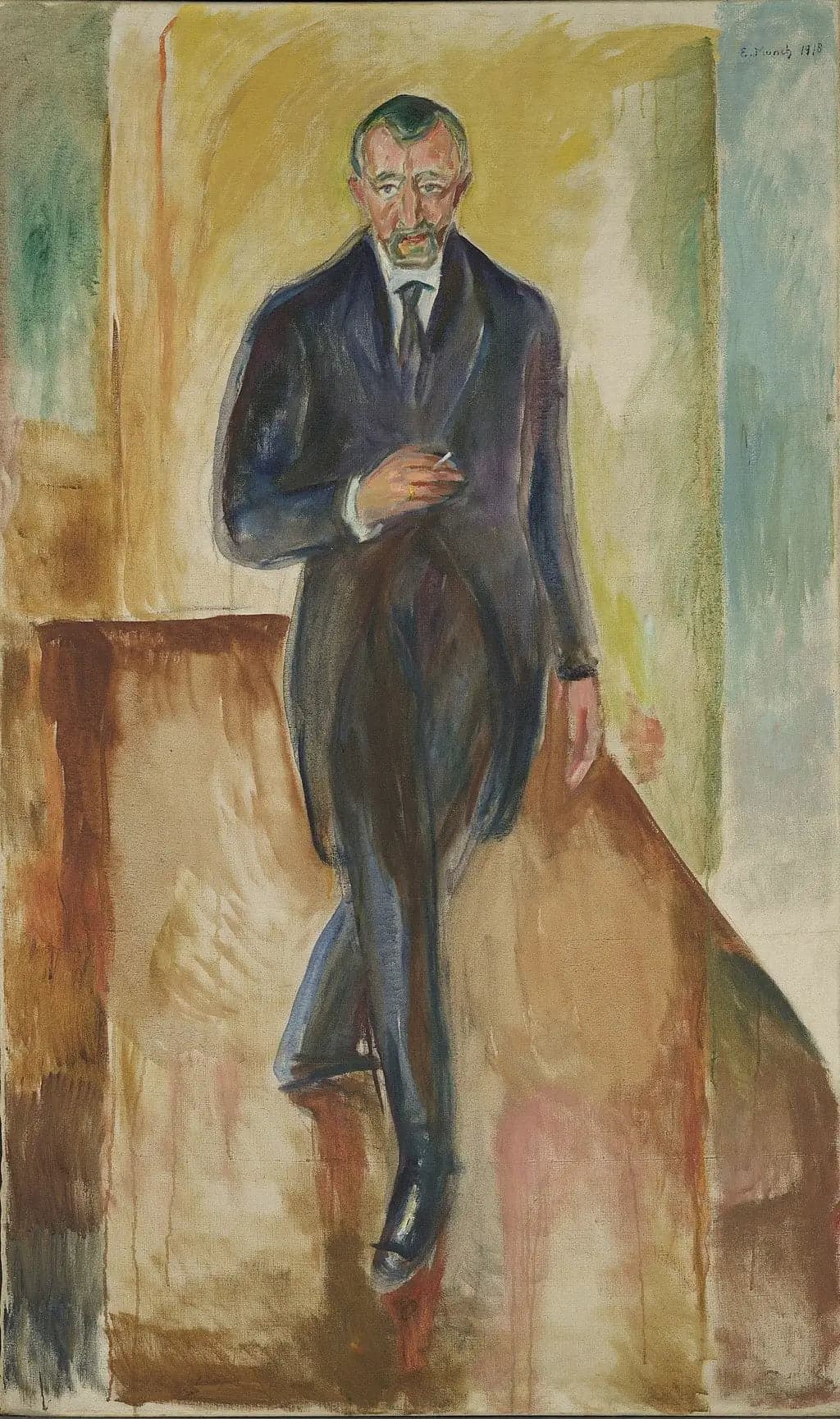
Thorvald Løchen
- Original dimensions
- 120 x 200 cm
- Museum
- National Museum
- Year
- 1918
Scene depicted
The painting Thorvald Løchen immortalizes a portrait that is both intimate and introspective, where the features of the subject blend into an atmosphere of melancholy. The work depicts a thoughtful man, lost in his reflections, surrounded by enchanting nature that seems to vibrate to the rhythm of his emotions. The absence of fictional details allows for a personal reading, enabling the viewer to fully immerse themselves in this poignant composition.
Historical context
Created in 1918, the painting titled Thorvald Løchen is the result of the fertile imagination of Edvard Munch , a pillar of symbolism and expressionism . This iconic canvas is currently located at the National Museum in Oslo, immersed in a crucial historical context in Norway. At that time, the world was slowly emerging from the shadows of World War I, and art served as a powerful mirror to human turmoil and complex feelings.
Place in the artist's career
Thorvald Løchen represents a turning point in Edvard Munch 's career. It is situated in a period of artistic maturity, as the artist had already explored the springs of the human condition in works such as The Scream and The Madonna . This masterpiece marks a transition to a more reflective style, where individual expression intertwines with collective contemplation, thus leaving an indelible mark in the history of art.
Anecdote
“Art does not seek to reproduce the visible, but to make visible what is not.” This quote from Edvard Munch resonates beautifully with Thorvald Løchen , born from the inspiration of a misty morning in Oslo, where the colors of the sky and the silhouettes of the trees danced in a silent symphony, awakening intense emotions. This canvas wonderfully captures the fragile essence of life, like a soft shadow on the face of nature.