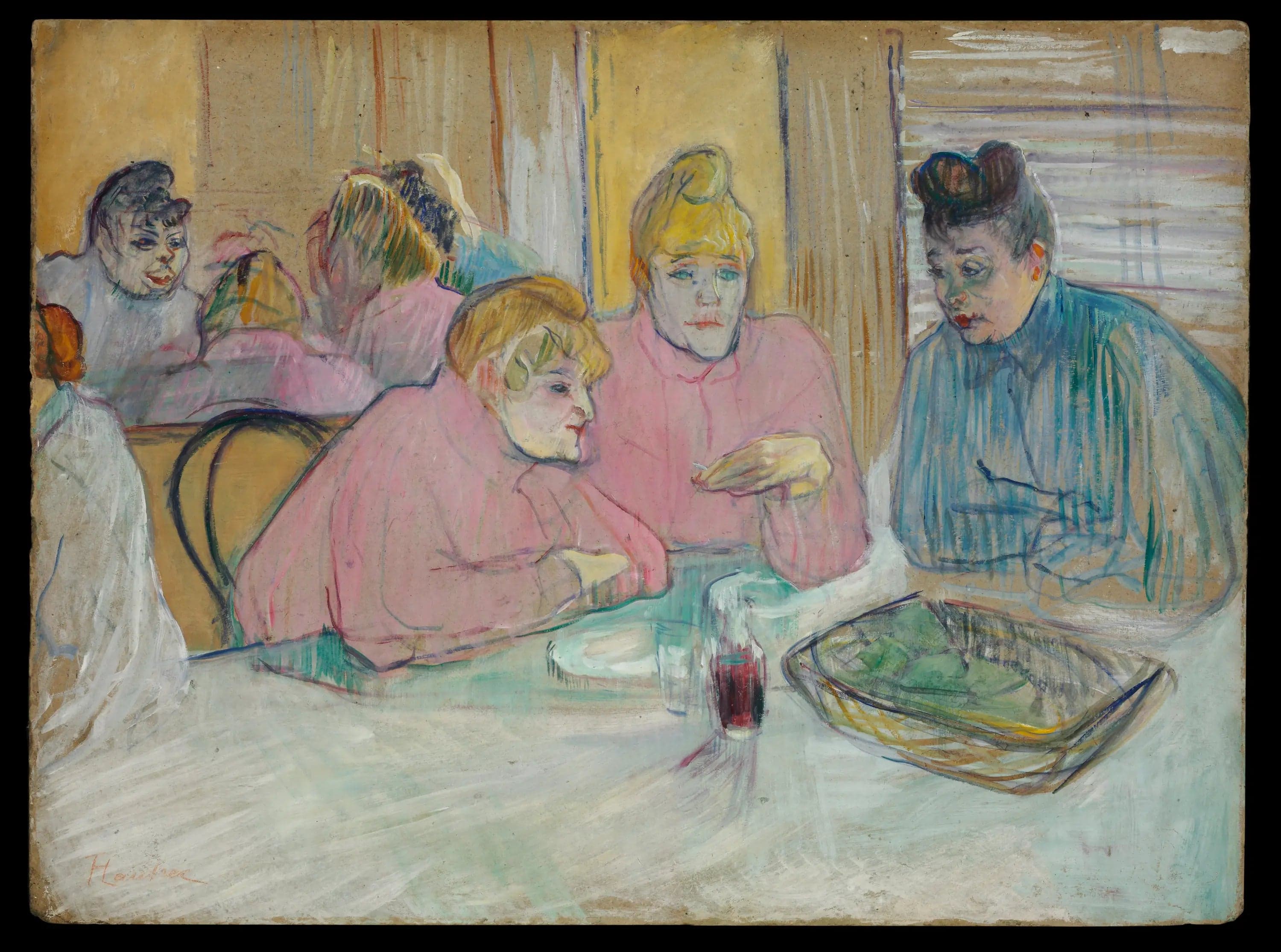
These Ladies in the Refectory - Henri de Toulouse
- Original dimensions
- 80.7 x 60.2 cm
- Museum
- Hungarian National Gallery
- Year
- 1894
Scene depicted
This captivating painting shows a group of women gathered around a table in a refectory, their faces revealing a variety of emotions. Each of them is a story in itself, encapsulating tales of camaraderie, solitude, or unexpressed desires. Their postures and expressions open a window into daily life in Paris, highlighting the subtleties of human interactions in a time of upheaval.
Historical context
Created in 1894, Ces Dames au réfectoire is set in bohemian Paris, a time marked by cultural exchanges and new forms of artistic expression. Under the influence of Post-Impressionism , this canvas captures the essence of a fleeting moment in an intimate place. Currently exhibited at the Hungarian National Gallery , this painting invites us to dive into the vibrant world of the 19th century.
Place in the artist's career
Positioning Ces Dames au réfectoire as a central milestone in Toulouse-Lautrec's career, this painting bears the marks of a pronounced artistic maturity. Compared to Au Moulin Rouge and La danse au Moulin Rouge , one can observe a technical evolution towards greater introspection and mastery of light play, creating a unique emotional depth.
Anecdote
“Art is the reflection of the soul, provided one knows how to observe.” These are words that Toulouse-Lautrec might have spoken as he sketched one summer morning, sculpting silhouettes in the trembling light. It is in this context that the evocative power of Ces Dames au réfectoire comes to life, a work that witnesses social rituals and the beauty of shared moments.