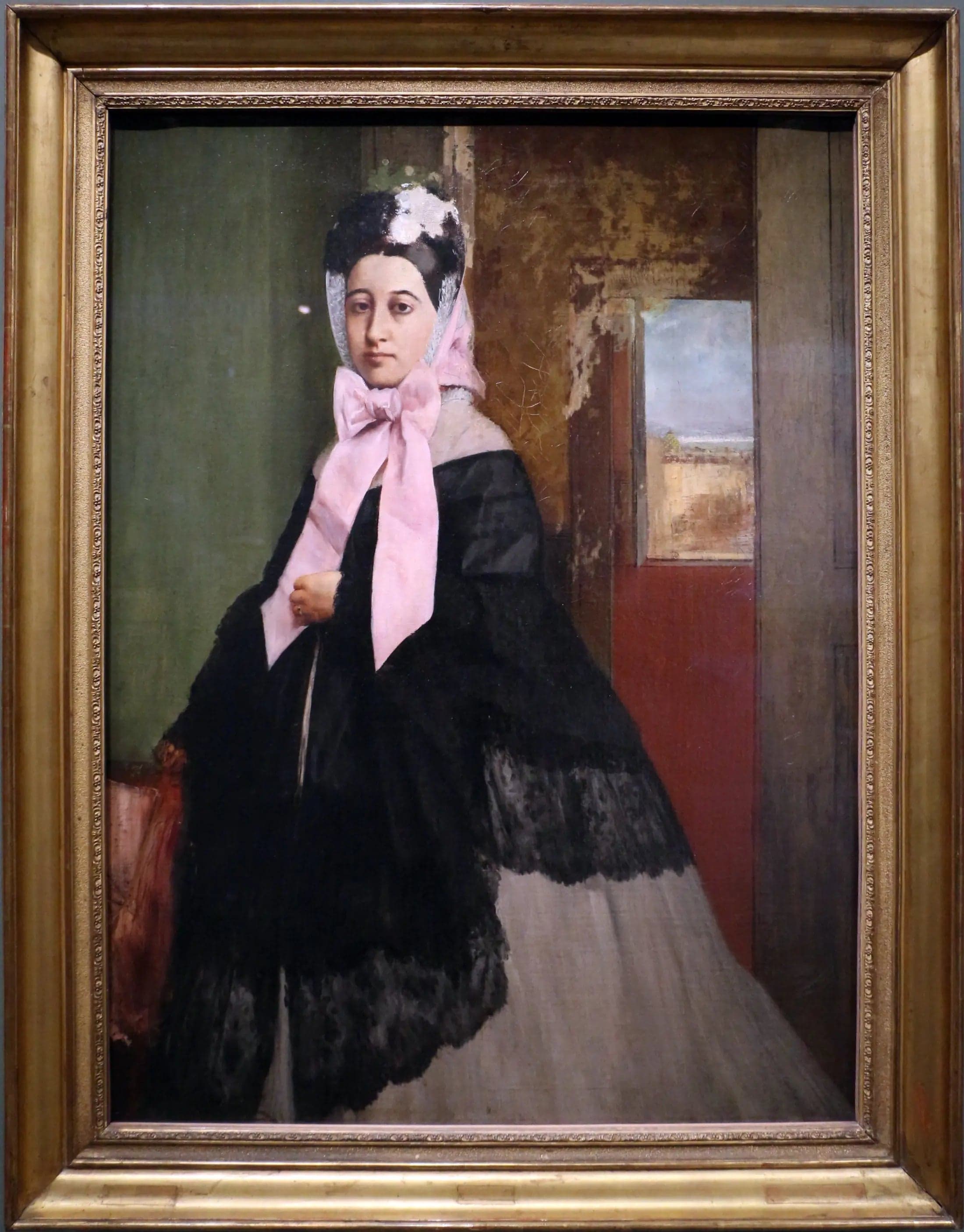
Thérèse de Gas
- Original dimensions
- 0.667 x 0.895 cm
- Museum
- Orsay Museum
- Year
- 1863
Scene depicted
This painting reveals a subtle complexity, immersed in a delicate atmosphere where Thérèse, the central figure, expresses more than just a simple gaze. Suspended between contemplation and action, she becomes the reflection of a modernity in motion, capturing the grace of an era. Degas's prowess lies in his ability to immortalize an emotion, a moment captured in the flow of time.
Historical context
Created in 1863, in Paris, the beating heart of the Impressionist movement, Thérèse de Gas stands out for its poignant representation of fleeting beauty. An era where artists sought to capture the moment, this painting is protected in the precious collections of the Orsay Museum , proudly displaying its intimate dimensions.
Place in the artist's career
Thérèse de Gas , at this moment in Edgar Degas 's career, appears as a decisive milestone. This painting , emerging from the artist's earlier research on the ballet scene and daily life, positions itself almost halfway between tradition and experimentation, recalling his works such as The Dance Class and The Dancers , which mark a palpable stylistic evolution.
Anecdote
“Beauty lies in the ephemeral, in that fleeting moment we must seize.” If Edgar Degas could have crossed paths with Thérèse on a sunny afternoon, this masterpiece is the result of inspiration rooted in the ordinary, yet sublimated by a master brush actor.