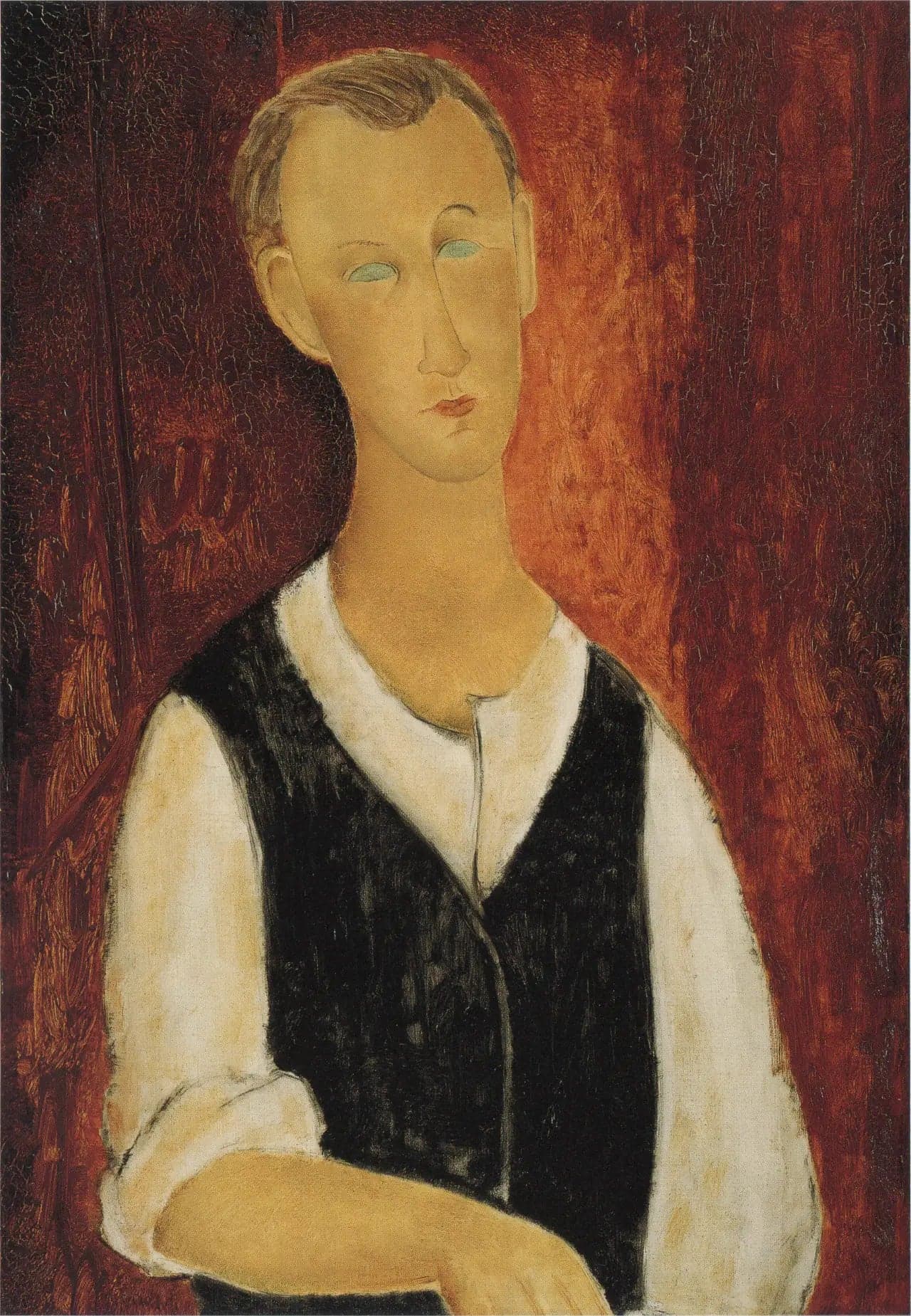
The Young Peasant
- Original dimensions
- 50 x 73.5 cm
- Museum
- Artizon Museum
- Year
- 1918
Scene depicted
The painting “The Young Peasant” captures a reflective posture, a face imbued with gentle melancholy. The elongated features, typical of Modigliani's style, outline a silhouette that seems to inhabit a world both timeless and intimate. The gaze of the young man invites us to perceive lost dreams and aspirations, transcending the everyday life of rurality.
Historical context
Created in 1918, during the tumultuous context of World War I, this painting illustrates the desire for escape and artistic renewal of the time. It is in Paris, the capital of the arts, that Modigliani shaped his unique vision, rooted in the expressionist movement. Today, this canvas rests at the Artizon Museum , a guardian of masterpieces, where it continues to evoke the emotional intensity of this crucial period.
Place in the artist's career
This canvas is part of a key period in Modigliani's career, marked by a departure from academic conventions. In his journey, “La belle Romaine” and “Nu couché” are his other iconic canvases that testify to the evolution of his style towards an unprecedented emotional depth, thus confirming his place among the great masters of the 20th century.
Anecdote
“Every face is a story to tell,” said Modigliani, inspired by the fleeting encounters of the Parisian alleys. In this masterpiece , he captures the reflection of a young peasant, a symbol of hope and simplicity, whom the artist met one bright morning. The energy of this encounter is found in the evocative strength of the painting .