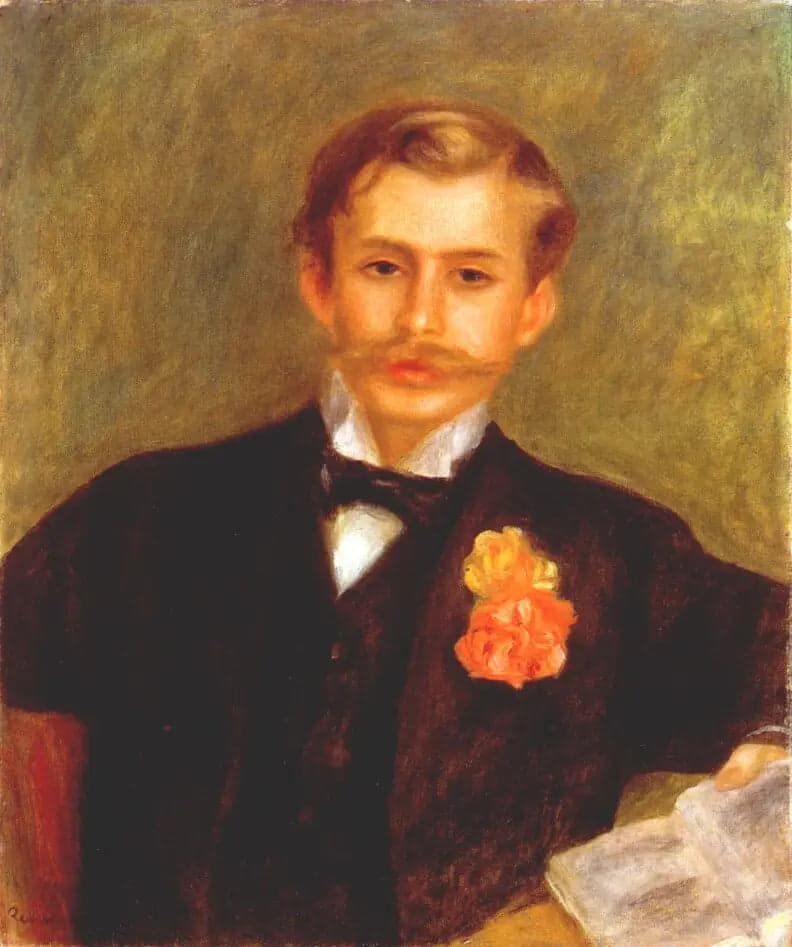
The Young Man with the Carnation - Pierre
- Original dimensions
- 46 x 55 cm
- Museum
- Norton Museum of Art
- Year
- 1900
Scene depicted
In this luminous composition, the young man stands adrift between the outside world and his inner self. His piercing and serene gaze contrasts with the vibrancy of the flowers surrounding him, bridging the gap between nature and the human soul. Thanks to Renoir's Impressionist painting , the viewer is transported into this emotional universe, rich in colors and sensitivity.
Historical context
Created at the turn of the 19th and 20th centuries, this painting embodies the Impressionist style, an artistic movement that advocates capturing the moment and the fleeting beauty of light and colors. Originally painted in Paris, this canvas is now housed at the Norton Museum of Art in Florida. It represents one of Renoir's major works, capturing the essence of the wonder of a youth full of promise.
Place in the artist's career
This painting marks a turning point in Renoir's career, where he begins to master the subtleties of light and form more and more. Alongside other famous works like “The Bathers” and “Luncheon of the Boating Party,” the canvas “The Young Man with the Carnation” illustrates the growing maturity of his Impressionist style, playing with reflections and human emotions.
Anecdote
“Light is my muse.” Such were Renoir's words, resonating as he painted this masterpiece on a sunny morning. It was in a fragrant garden of carnation flowers that the artist found inspiration. This suspended moment, filled with warmth and sweetness, is lost in the intimacy of his canvas , transforming light into a caress on the young man's face.