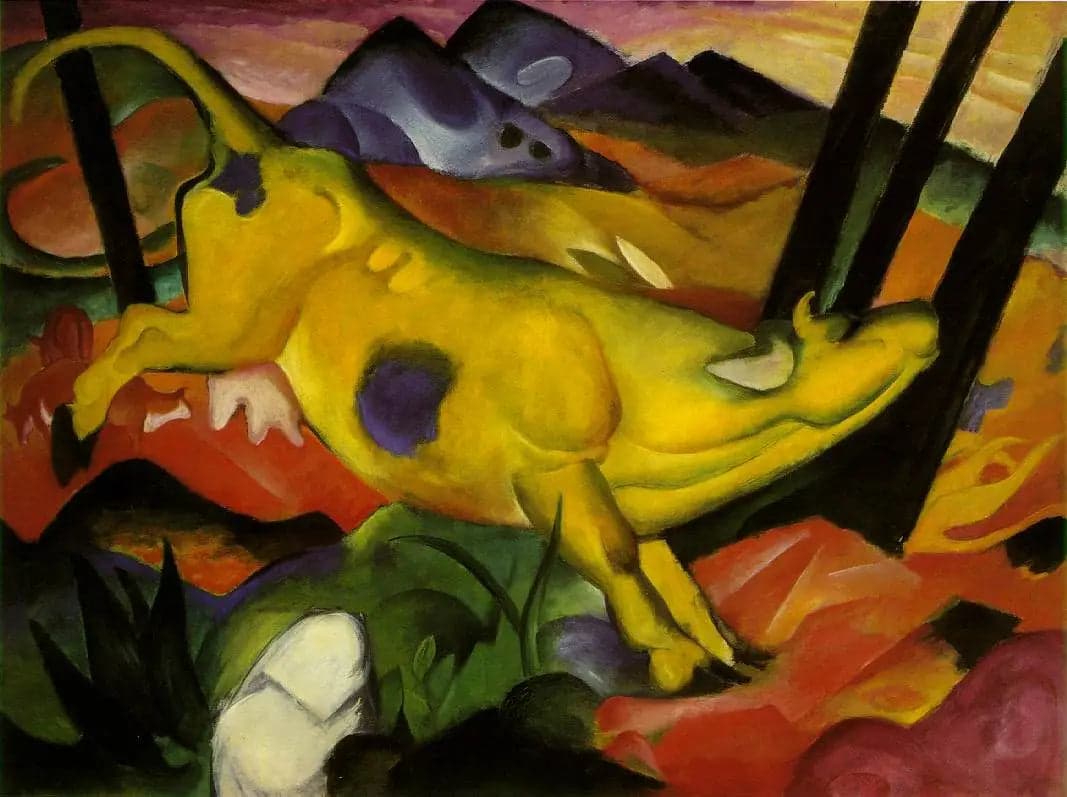
The Yellow Cow
- Original dimensions
- 189.2 x 140.5 cm
- Museum
- Solomon R. Guggenheim Museum
- Year
- 1911
Scene depicted
In this painting , a yellow cow stands majestically amidst a stylized landscape. The transcendent treatment of forms and colors creates an almost dreamlike ambiance. Marc celebrates animal beauty, innocence, and freedom, while exploring universal themes of duality between man and nature.
Historical context
Created in Munich, in the heart of Germany, in 1911, the painting “ The Yellow Cow ” is part of the expressionist movement. This artistic period, vibrant with colors and emotions, sees Franz Marc stand out with his bold approach to nature and forms. The canvas , now displayed at the Solomon R. Guggenheim Museum , measures 189.2 x 140.5 cm, reflecting the grandeur of the work, both visually and conceptually.
Place in the artist's career
“ The Yellow Cow ” marks a turning point in the career of Franz Marc . After initial explorations in figurative painting , this pictorial work announces his mature style, rich in symbolism. Compared to his canvas “ The Large Blue Horse ” and “The Menagerie,” this work shows an evolution where color and form harmonize to express deep emotions.
Anecdote
Franz Marc once declared: “Art is the color of the soul.” Inspired by bucolic landscapes and animals, he captured, during a morning walk in spring, the essence of life. It is in this bright and fragrant atmosphere of flowers that “ The Yellow Cow ” was born, forming a palpable link between man and nature, while revealing the depth of his masterpiece .