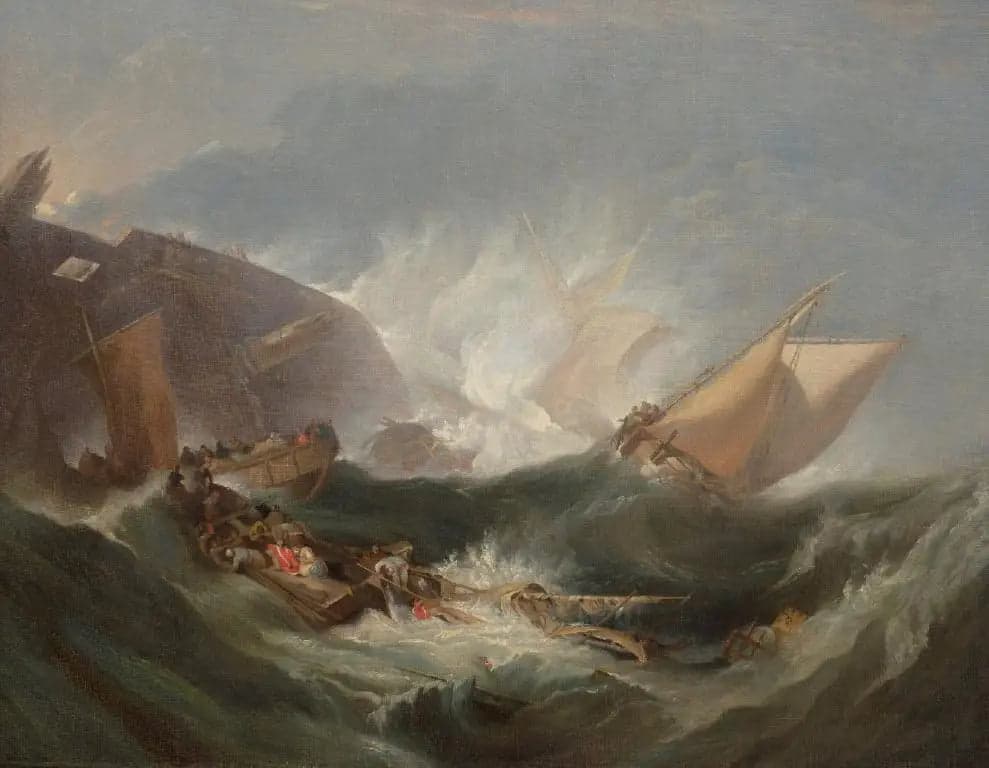
The Wreck of a Transport Ship
- Original dimensions
- 52.1 x 87.6 cm
- Museum
- Auckland Art Museum
- Year
- 1810
Scene depicted
In this pictorial work, Turner captures the tragic moment of a ship sinking beneath the threatening waves. The sailors, cornered into despair, struggle against the elements, while the vaporous hues of the water and sky resonate with the echo of chaos in the face of nature's power. The blurred horizon suggests a floating reality, almost dreamlike, reflecting an imminent disaster and a disturbing beauty.
Historical context
Created in 1810, this painting emblematic of J. M. W. Turner sits at the crossroads of the Industrial Revolution and the beginnings of the romantic movement. The artist, who worked extensively in London, offers us a composition rich in emotions, a poetic momentum rooted in his time. The painting is currently housed in the Auckland Art Museum, where it continues to inspire visitors with its grandeur and intensity.
Place in the artist's career
The Wreck of a transport ship marks a significant milestone in Turner's career. This painting, combining technique and emotion, represents a period of maturity, where the artist sublimates his style. It could be paralleled with the famous “Rain, Steam and Speed” and “The Fighting Temeraire,” two other paintings that demonstrate his evolution in the use of light and space.
Anecdote
“Light and water, my dear friends, are my most faithful allies,” Turner might have said while contemplating the tumultuous waves that inspired his canvas . Let us evoke this precise moment: one morning on the coast where the wind carries with it whispers of the sea, and where each glint of the sun reveals the soul of the raging waves. It is this electric atmosphere that nourished the evocative power of The Wreck of a transport ship .