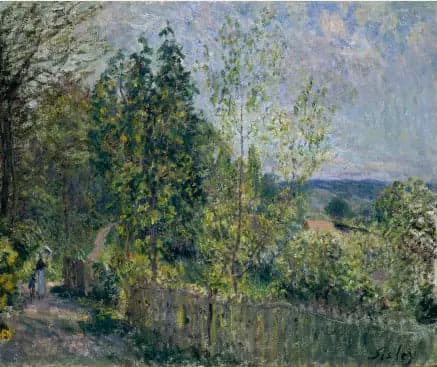
The Wooded Road
- Original dimensions
- 55.8 x 46.3 cm
- Museum
- National Gallery of Art
- Year
- 1879
Scene depicted
In the painting "The Wooded Road," we discover a peaceful scene, a path surrounded by trees with dense foliage. The composition invites a quiet stroll, where natural colors intertwine to bring the essence of nature to life. Light plays subtly, bringing an atmosphere of serenity. This canvas is a tribute to the tranquil beauty of the French countryside.
Historical context
Created in 1879, this painting finds its roots in the charming town of Moret-sur-Loing, located in the Île-de-France region, which is the cradle of the Impressionist movement. The work testifies to a time when artists sought to capture light and nature with penetrating precision. Today, this majestic canvas is displayed at the National Gallery of Art , where its charm continues to dazzle visitors.
Place in the artist's career
"The Wooded Road" fits into Sisley's career as an example of his Impressionist period, demonstrating his mastery of shadows and light. Alongside works such as "The Bridge of Villeneuve-la-Garenne" and "The Seine at Argenteuil," this canvas illustrates a stylistic maturity, and his evolution towards bolder and brighter compositions.
Anecdote
“Every morning, I wake up with the hope of capturing the ephemeral beauty of light,” said Sisley. It is this aspiration that led him to immortalize a spring morning on the canvas , where every blade of grass, every ray of sunshine, seems to almost vibrate with its own life. This painting encapsulates this fleeting essence, making it eternal.