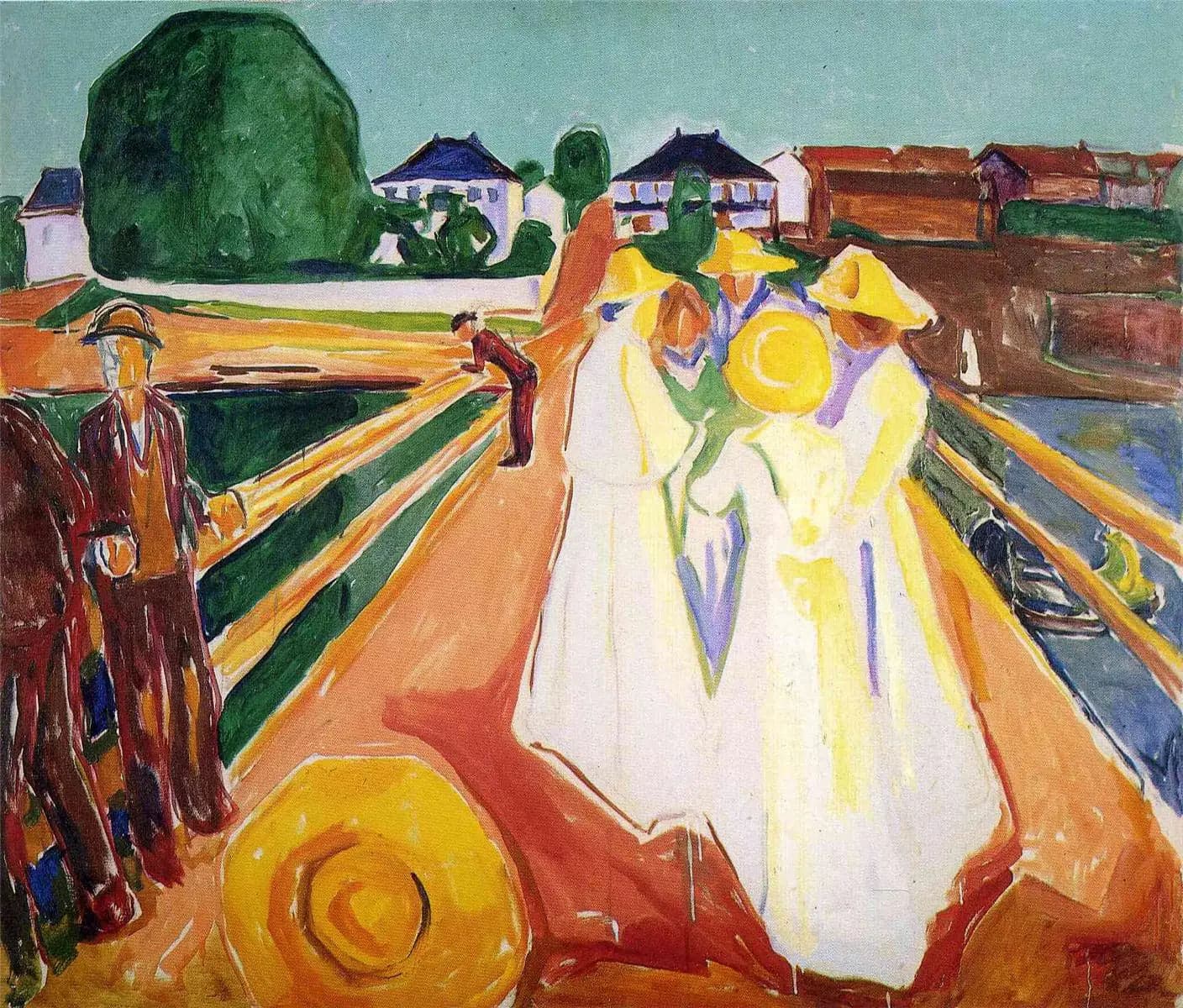
The Women on the Bridge
- Original dimensions
- 230 x 203 cm
- Museum
- Thiel Gallery
- Year
- 1903
Scene depicted
In this painting, Munch captures the fragility of human connections. Immobile on a bridge, with a gaze both present and distant, the women exchange words that the viewer cannot hear, but felt in the vibrant silence of the painting . With bodies clustered yet expressive, each figure carries within it a silent story that prompts contemplation.
Historical context
Created in 1903 in Oslo, the painting The Women on the Bridge is part of the expressionist movement, led by Edvard Munch , an iconic figure of modern art. It is in this context of artistic renaissance in Europe, a moment when human emotions take precedence over objective reality, that Munch offers the world this painting now preserved at the Thiel Gallery. Honoring magnificent dimensions of 230 x 203 cm, this canvas invites exploration of the psychological and social landscapes of its time.
Place in the artist's career
The Women on the Bridge is part of a pivotal period in Munch's career, where his style evolves towards bolder forms and more introspective themes. Compared to The Scream and The Madonna , this painting highlights his interest in human psychology, through an expressive approach that redefines the visual experience.
Anecdote
“Every color has a voice, and in silence, they sing!” said Munch. As he strolls through a blooming garden one spring morning, the artist catches the gaze of women talking on a bridge. This fleeting moment becomes the spark of inspiration for the masterpiece that is The Women on the Bridge . The captured emotions resonate beyond the frame, offering a timeless visual melody.