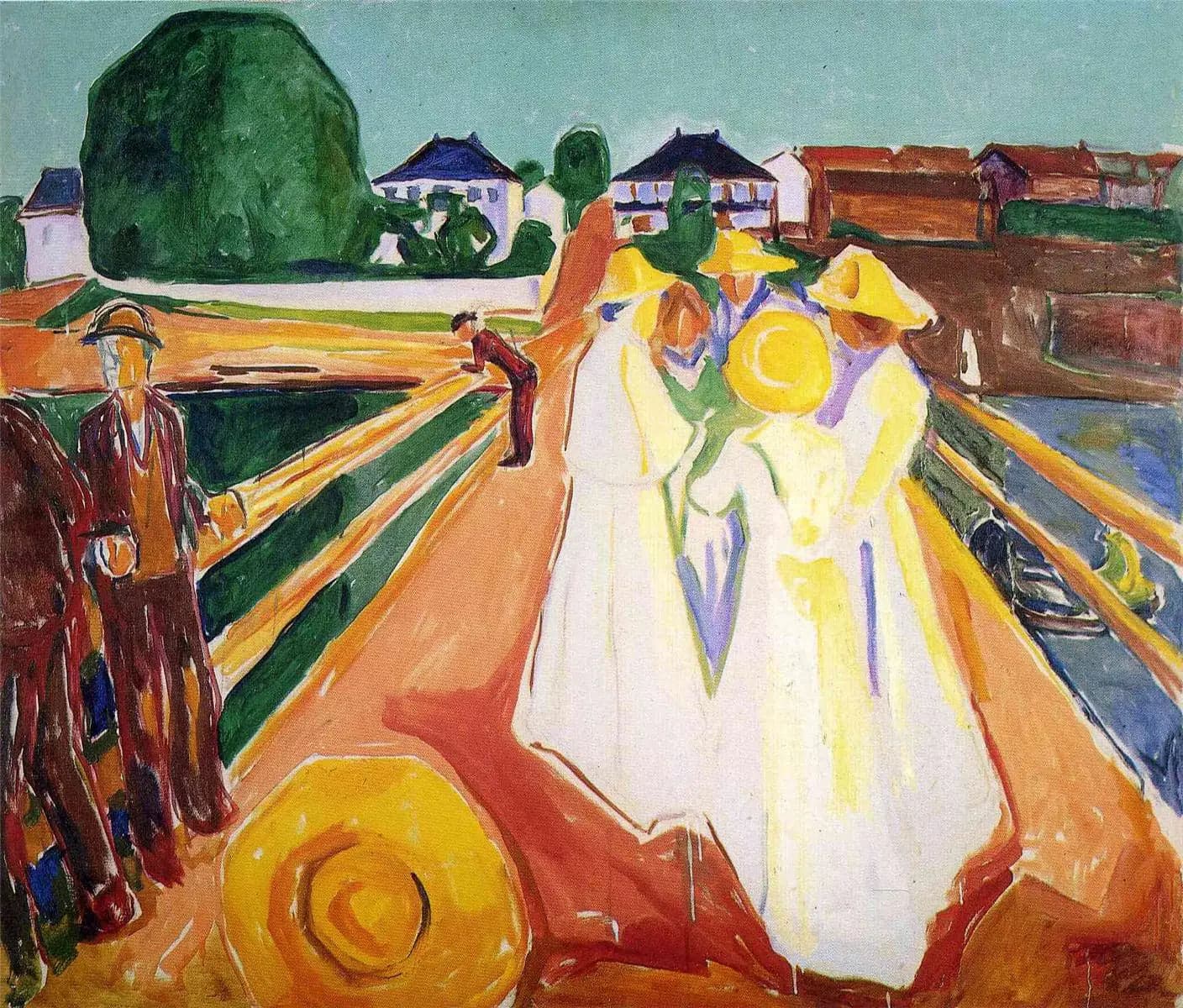
The Women on the Bridge
- Original dimensions
- 80.5 x 90.5 cm
- Museum
- Not specified
- Year
- 1903
Scene depicted
In this composition , Munch captures the fleeting moment of two women on a bridge, their silhouettes standing out against an indistinct landscape. This canvas evokes both solitude and connection, the women symbolizing the link between the individual and their environment. The nuanced colors and fluid lines echo the collective state of mind of the time.
Historical context
Created in 1903, this painting , emblematic of Nordic expressionism , finds its roots in the vibrant city of Oslo, Norway. This canvas conveys the essence of an era where art seeks deep emotions, reflecting the turmoil of the human soul. The painting speaks to us of love and melancholy, offering a poetic glimpse into everyday life.
Place in the artist's career
The Women on the Bridge marks a key milestone in Munch's career, illustrating a period of artistic maturity. Alongside his famous painting The Scream and The Madonna , this painting brings forth themes of vulnerability and human connection, showing the evolution of his style towards more introspective and powerful compositions.
Anecdote
“I paint my memories, what remains in me after the passage of time,” Munch might have said while thinking of his masterpiece. Imagine him, one spring morning, a light mist rising as he observes two female silhouettes on a bridge, their faces expressing a mix of thoughts and emotions. This is where the evocative power of The Women on the Bridge is born.