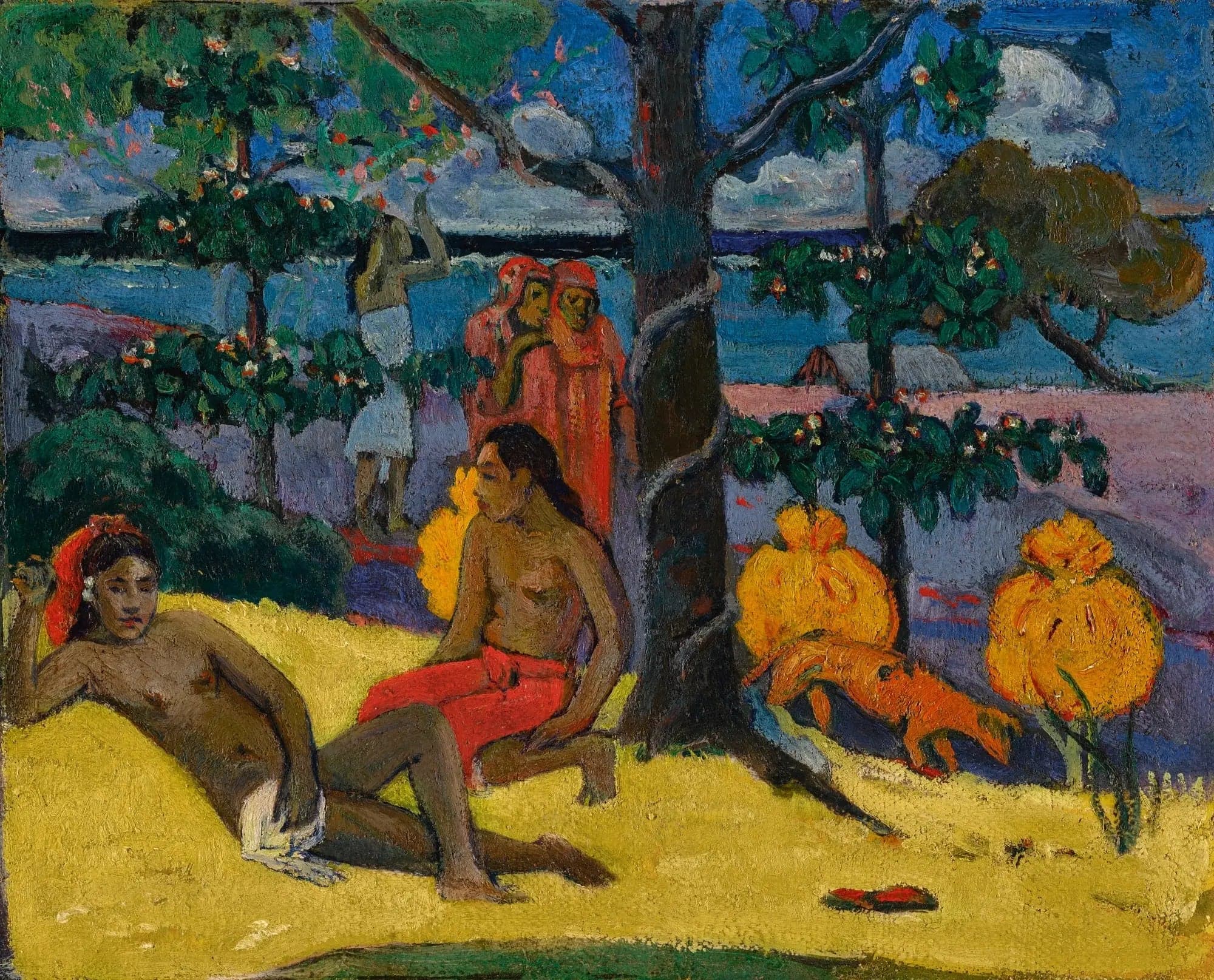
The Woman with Mangoes II
- Original dimensions
- 32.7 x 26.2 cm
- Museum
- Not specified
- Year
- 1896
Scene depicted
In this canvas , the woman's gaze lights up at the touch of the mangoes, a source of life and abundance. The air is filled with tropical fragrances, and the sun's rays filter through the foliage. This painting strikes with the material presence of the fruits, symbols of sensuality and exoticism, meeting the delicacy of the feminine silhouette that holds them.
Historical context
Created in 1896, The Woman with Mangoes II is a vibrant visual statement that emerges from the sunny shores of Tahiti, where Paul Gauguin sought refuge and inspiration away from Western artistic norms. This painting is emblematic of the post-impressionist movements, a meeting point between emotion and color, which took root at the heart of the late 19th century. Today, this painting is found in private collections, thus preserving its spiritual essence.
Place in the artist's career
The Woman with Mangoes II marks a pivotal period in Gauguin's career, where he abandons academic conventions to explore bolder and idiosyncratic compositions. This painting comes just after Nafea Faa Ipoipo, another famous painting that testifies to his immersion in the Tahitian world. Together, these works illustrate his evolution towards a freer and more expressive approach.
Anecdote
Gauguin once confided: “I am just a dreamer trying to capture the soul of ephemeral beauty.” This masterpiece was inspired by a chance discovery in a local market, where the artist was enchanted by the colorful mangoes and the grace of the women of Tahiti. This painting can be seen as an ode to exuberant beauty and the simplicity of island life.