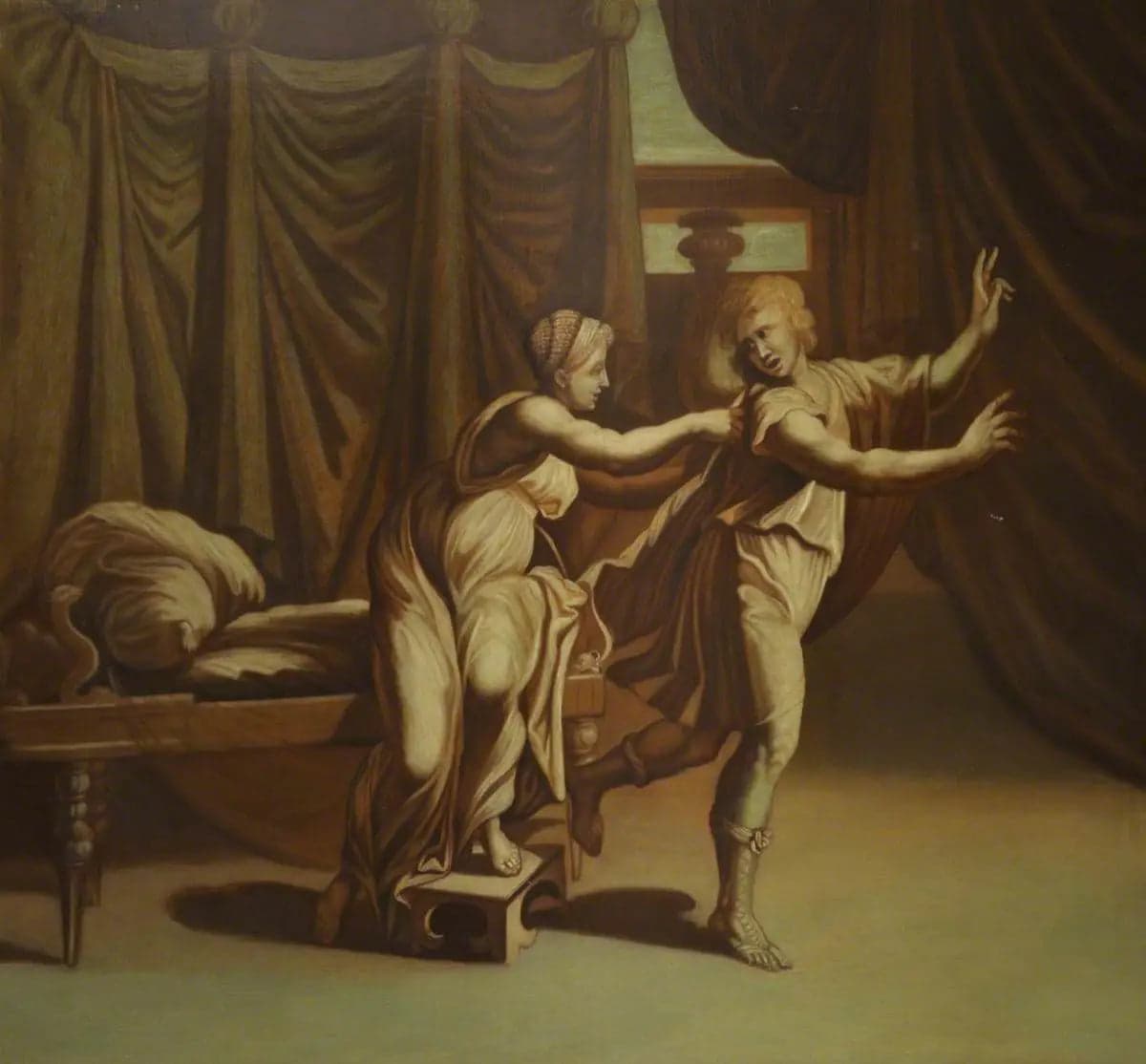
The Woman of Potiphar
- Original dimensions
- 104.4 x 91.3 cm
- Museum
- All Souls College
Scene depicted
In this painting , Raphael presents a dramatic scene inspired by the Old Testament, where the wife of Potiphar attempts to seduce Joseph. The intense gaze, the awkward position, and the gestures of the characters capture the tension of this crucial moment, illustrating both passion and moral conflict. This visual composition chosen by Raphael immerses us in a complex narrative of desire and resistance.
Historical context
Created during the period of the Italian Renaissance , the painting "The Wife of Potiphar" is a masterpiece by the famous artist Raphael. Executed in Rome, this pictorial work belongs to the artistic movement of the High Renaissance . Currently, the painting is displayed at All Souls College in Oxford, where it attracts the attention of art lovers and historians for its rich cultural and historical context. The dimensions of this canvas add to its majesty, measuring 104.4 x 91.3 cm.
Place in the artist's career
"The Wife of Potiphar" is situated at a key moment in Raphael's career, marking the stylistic peak of his work. When compared to two other iconic paintings like "The Sistine Madonna" and "The Parthenon," one observes a technical evolution in the play of light and the representation of the subjects' emotions. These works together depict a growing mastery in the manipulation of visual narratives.
Anecdote
Today, one can imagine Raphael, on a sunny morning in Rome, drawing inspiration from the golden light that bathed the city. He once said: "Art is the mirror of the soul." This phrase perfectly summarizes the essence of his masterpiece , where the psychological depth of the characters resonates with the palpable emotion of the scene.