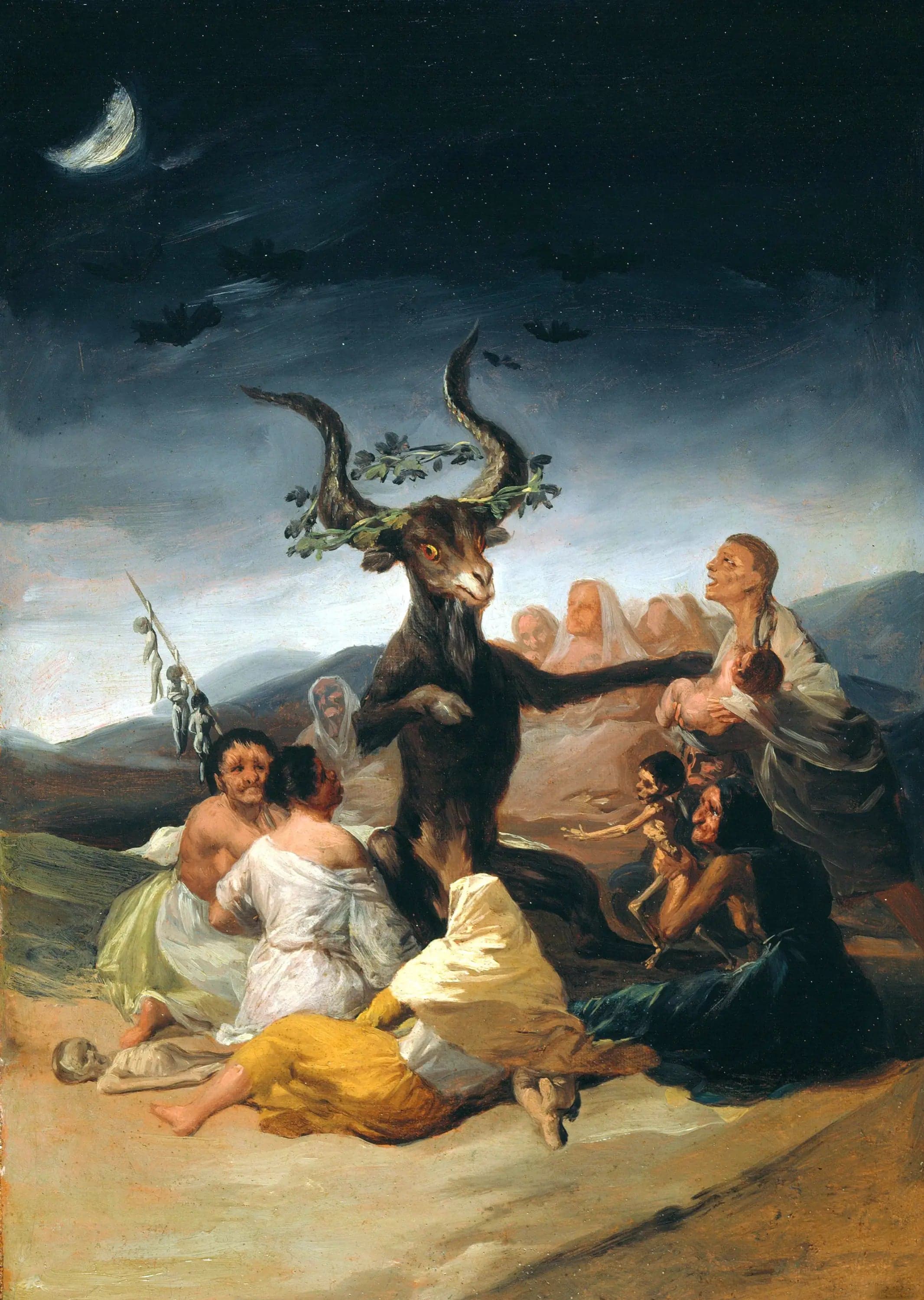
The Witches' Sabbath
- Original dimensions
- 438 x 140 cm
- Movement
- romanticism
- Museum
- Prado Museum
- Year
- 1820
Scene depicted
The canvas “The Witches' Sabbath” reveals a nocturnal ceremony surrounded by grotesque creatures and men in the grip of fear. Goya, through his painting , depicts a macabre dance where the boundaries between the real and the fantastic blur, tolling the bell for an era steeped in superstition and mystery.
Historical context
Created in 1820, this painting embodies the romantic Spain, reflecting a tormented and mystical world. The canvas , currently displayed at the Prado Museum in Madrid, bears witness to the exploration of dark themes characteristic of this era where Goya unveils the meanders of the human soul through a captivating composition.
Place in the artist's career
At this point in his career, Goya explores dark shores with The Witches' Sabbath , a significant work adjacent to “La Maja Desnudada” and “The Disasters of War,” showing an evolution in the use of light and the emotional intensity of his canvases .
Anecdote
“The shadow of the night inspires visions that the light of day will never dare to touch,” Goya might have said while referring to his masterpiece . Each brushstroke evokes the memory of a haunting evening, a starry night where the imagination is unleashed, making The Witches' Sabbath a fascinating pictorial work.