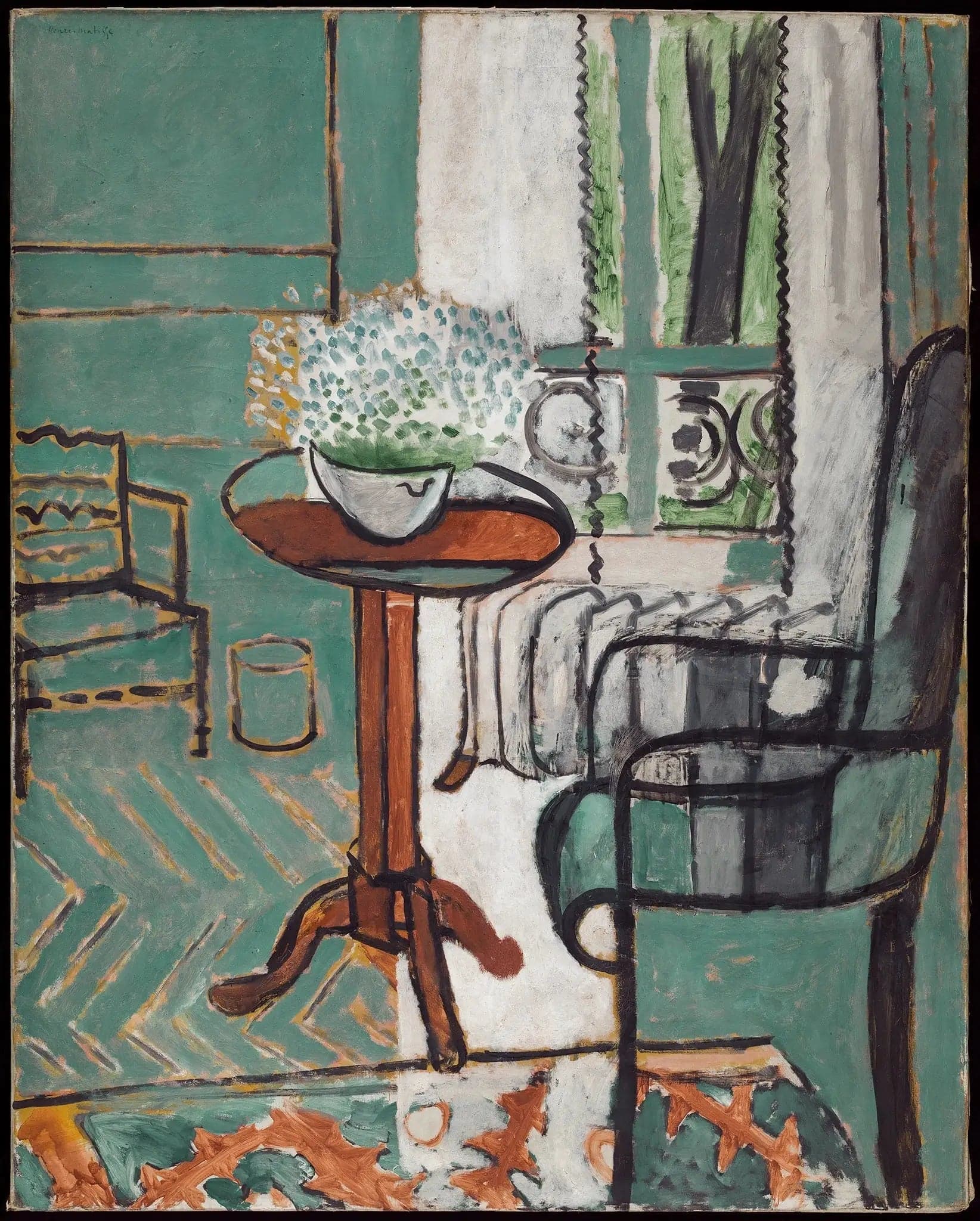
The Window
- Original dimensions
- 116.8 x 146.1 cm
- Museum
- Detroit Institute of Arts
- Year
- 1916
Scene depicted
In The Window , Matisse stages a bright interior. The gaze escapes the walls to explore the outside, marveling at a vibrant landscape where the blue sky blends with the intense greens of the vegetation. This painting transcends the simple representation of a space; it becomes an invitation to explore the connection between man and his environment. The colorful shapes intertwine, evoking a sense of peace and escape far beyond the canvas.
Historical context
Created in 1916 in Issy-les-Moulineaux, in the heart of the Fauvist movement, the painting titled The Window is set in a time when art frees itself from conventions. Matisse, a leader of this bold movement, captures light and color with such intensity that his canvas does not merely represent: it awakens, it vibrates. Currently exhibited at the Detroit Institute of Arts , this pictorial work , immense and captivating, measures 116.8 x 146.1 cm, a size that gives it a striking visual impact.
Place in the artist's career
The Window represents a crucial period in Matisse's career. Placing art at the crossroads of Fauvism and expressionism, this canvas illustrates his artistic maturity. When compared to other iconic canvases like The Dance and The Joy of Life , one perceives the stylistic evolution of the artist, who, over time, learns to play even more boldly with light and color.
Anecdote
“Color is the key to my painting,” Matisse might have declared one sunny morning as he contemplated the window of his studio. This fleeting moment, imbued with light, became the spark of his masterpiece . The canvas , of apparent simplicity, nonetheless conveys emotional depth, capturing the distant sounds of nature, the scent of blooming flowers, and the gentle warmth that envelops the body.