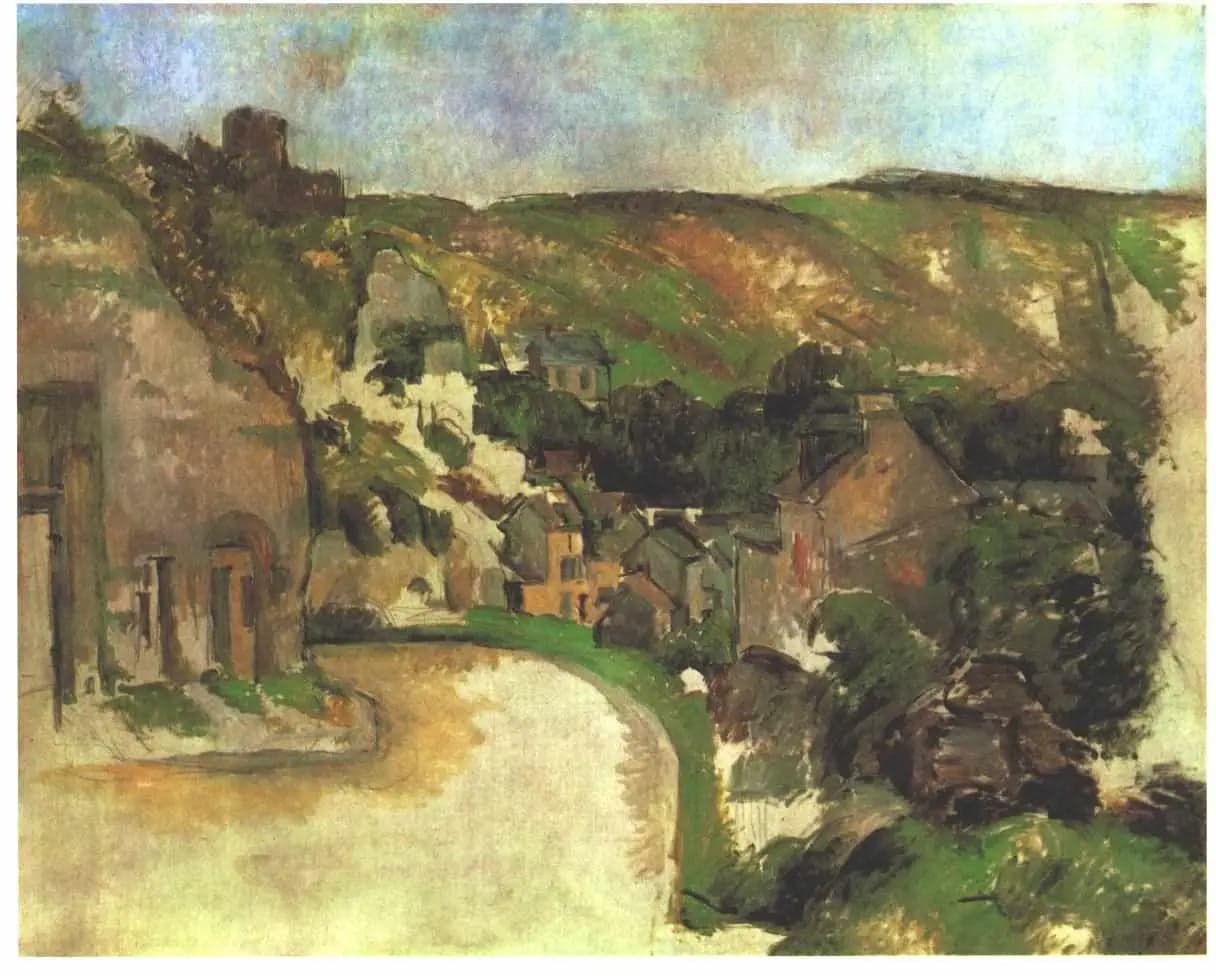
The Winding Road at La Roche-Guyon
- Original dimensions
- 75.5 x 62.2 cm
- Museum
- Smith College Museum of Art
- Year
- 1885
Scene depicted
In this composition, Cézanne immerses us in the heart of a winding path that snakes through the lush landscape of La Roche-Guyon. The play of shadows and light, through the artist's delicate brushstrokes, evokes not only the palpable reality of the scene but also a sense of movement, an invitation to explore the contours of this fresh morning.
Historical context
Painted in 1885, “The Winding Road at La Roche-Guyon” is at the heart of the Impressionists and pre- Impressionists in France. This painting, created in the picturesque setting of La Roche-Guyon, rises as a testament to the natural beauty of the Parisian region. Currently, this work is carefully preserved at the Smith College Museum of Art , a sanctuary for lovers of painting. Its dimensions, 75.5 x 62.2 cm, reflect Cézanne's ability to capture vast landscapes on a controlled surface.
Place in the artist's career
“The Winding Road at La Roche-Guyon” marks a pivotal phase in Cézanne's career, a period where his stylistic explorations lead him to reconnect with color and structure. To be paralleled with “The Large Bathers” and “Mont Sainte-Victoire,” this canvas illustrates his journey towards intuitive abstraction, where each painting becomes a unique work of art, independent of its time.
Anecdote
“Light dances on nature just as emotions do in a living heart.” These words could emanate from Paul Cézanne as he painted this canvas, inspired by a cool spring morning, as the ardor of a new day illuminated the peaceful village. This painting resonates with cherished memories, recalling the gentle rustling of leaves in the wind and the earthy scent of nature.