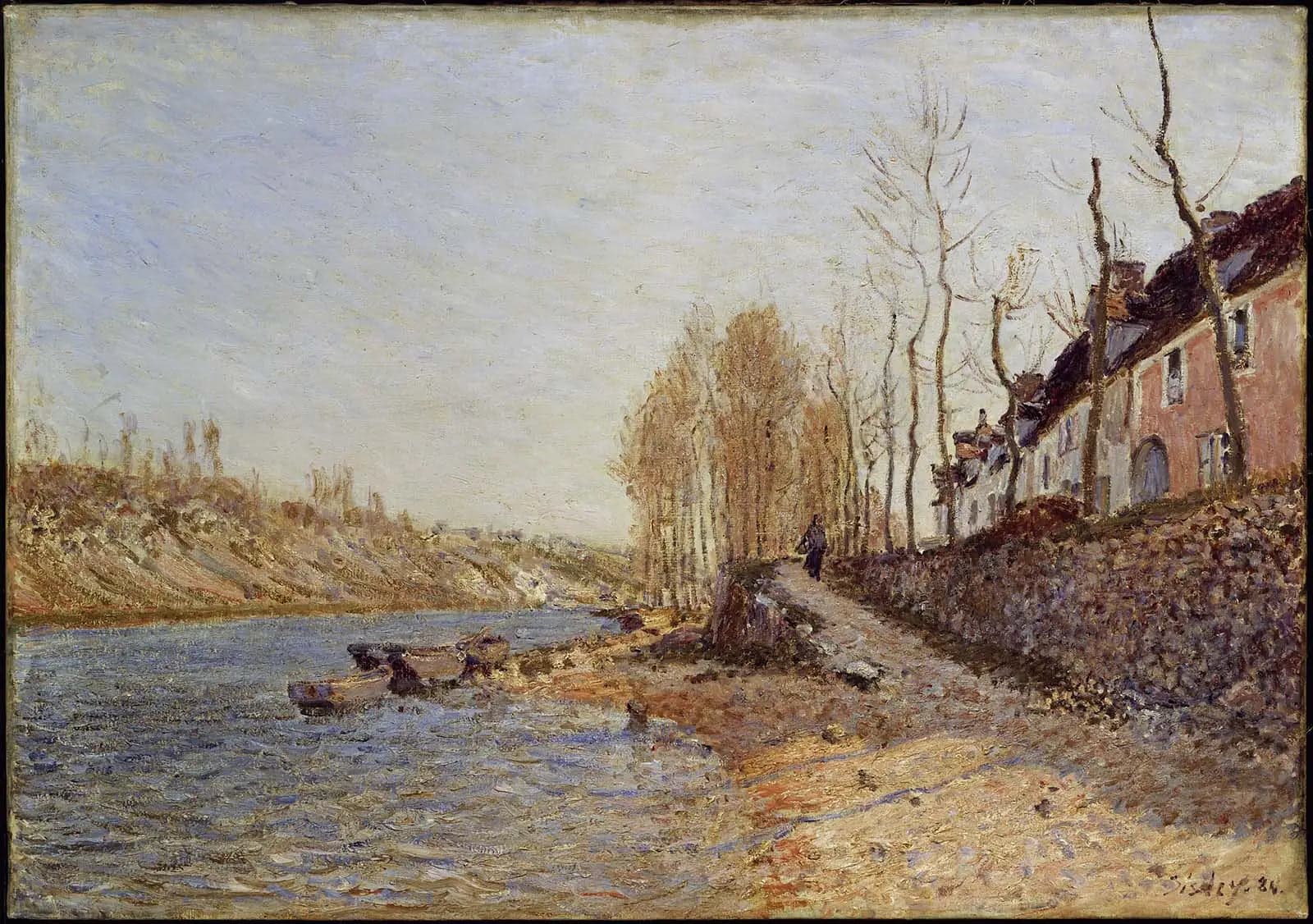
The White Cross at Saint-Mammès
- Original dimensions
- 92.4 x 65.4 cm
- Museum
- Museum of Fine Arts Boston
- Year
- 1884
Scene depicted
This painting depicts a peaceful scene where the harmony between man and nature is palpable. The canvas highlights the moored boats, while the light plays on the river, creating reflections that only Sisley knows how to dramatize. Here, each element tells a story of tranquility, gentle movement, and the impressionist era that envelops this pictorial work.
Historical context
Created in 1884, this painting takes place in Saint-Mammès, a charming port located at the intersection of the Seine and the Loing, thus expanding the impressionist landscape in which Sisley excels. This painting stands out in the impressionist movement, a period where light and color transcend form. Currently, this canvas is carefully preserved at the Museum of Fine Arts Boston , testifying to an unparalleled artistic craftsmanship. The dimensions of this composition give it an imposing presence, attracting the admiration of connoisseurs.
Place in the artist's career
La Croix-Blanche à Saint-Mammès fits perfectly into Sisley's maturity, a period where he establishes his recognition in the impressionist movement. In parallel, his works such as Les Saisons and Le Pont de Villeneuve-la-Garenne demonstrate a technical evolution that highlights his refinement in capturing light and movement.
Anecdote
“Nature is a living painting. Every time I lay my eyes on it, I marvel at its beauty.” This quote from Alfred Sisley resonates with the conception of La Croix-Blanche à Saint-Mammès . Imagine a spring morning, where the soft rays of the sun caress the calm waters of the river, a suspended moment, exalting the art of painting vibrant landscapes filled with emotion.