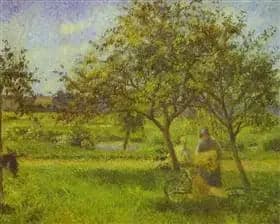
The Wheelbarrow, Beadle
- Original dimensions
- 64.5 x 53.5 cm
- Museum
- Orsay Museum
- Year
- 1879
Scene depicted
This painting depicts a moment suspended in time, where a humble beadle pushes his wheelbarrow through an urban landscape, symbolizing both daily labor and the beauty of lived scenes. The vibrant details of this painting reveal a world of light filtered through the trees and soft shadows, offering a poetic reading of the simplicity of life.
Historical context
Created in 1879, this painting is emblematic of the vibrant Impressionist movement, at the heart of Paris where Camille Pissarro , a prominent figure of this era, managed to capture the essence of French rural life. Today, this masterful canvas proudly resides at the Orsay Museum , a true sanctuary of Impressionist art, celebrating its invaluable historical and artistic heritage.
Place in the artist's career
Considered a milestone in Pissarro's career, The Wheelbarrow, Beadle marks a period of artistic maturity. Compared to the painting “The Potato Harvest” and “The Artist's Garden at Éragny,” it reflects the evolution of Impressionist technique, revealing a growing mastery of light and textures.
Anecdote
“Painting is the gaze of the soul.” Pissarro declared on a gentle spring morning in the bustling streets of Paris. It was during these fleeting moments that he crossed paths with the shadows of a beadle and his wheelbarrow, capturing not only the light and colors but also a deep emotion, always present in The Wheelbarrow, Beadle .