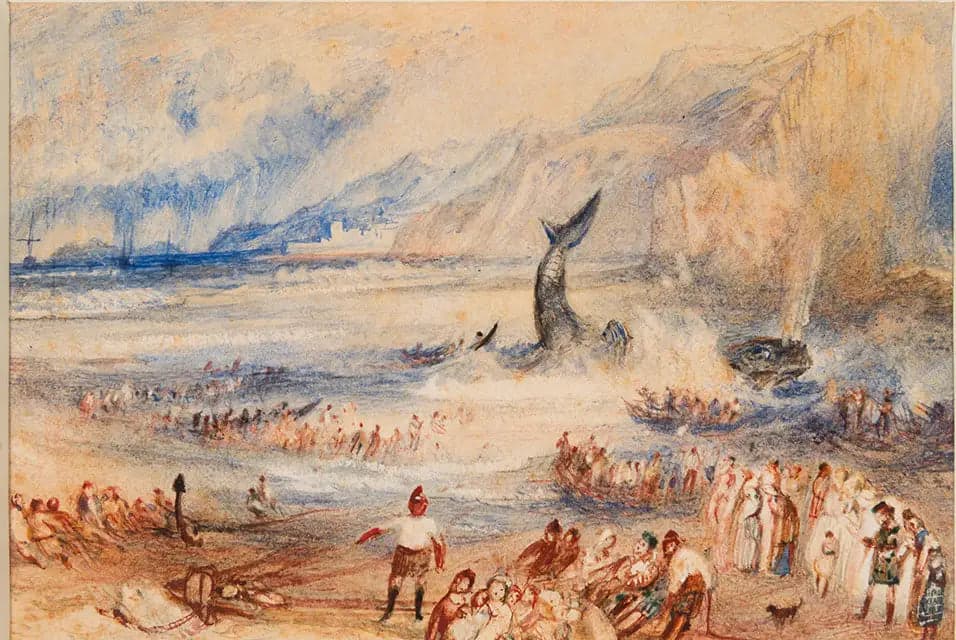
The Whale on Shore
- Original dimensions
- 5.6 x 4 cm
- Museum
- Taft Museum of Art
- Year
- 1837
Scene depicted
In this composition , Turner transports us to a beach where the immensity of the ocean confronts the tragedy of nature. The whale, massive and majestic, lies on the sand, a symbol of a lost struggle between man and natural forces. This painting is part of the romantic tradition, revealing the sublime confrontation between man and his environment.
Historical context
Created in 1837, this painting is set in the romantic context of the 19th century, as Turner disturbed the conventions established by classical art. Located in Cincinnati, Ohio, at the Taft Museum of Art, this canvas of modest dimensions contains a world where nature and the pictorial work meet. The artist, a pioneer of the impressionist movement, captures the fleeting moment of existence, thus laying the foundations for a radical change in the perception of painting .
Place in the artist's career
The Whale on Shore marks a turning point in Turner’s career, reflecting his mature period. Compared to other iconic paintings like “The Fighting Temeraire” and “Rain, Steam and Speed,” it illustrates his stylistic refinement and obsession with light and movement, depicting the duality of the human condition.
Anecdote
“Nature is silent poetry; you just have to know how to listen.” On that spring morning, Turner stood by the sea, captivated by the tragic sight of a beached whale. This fleeting moment imprinted on his mind, infusing the very essence of The Whale on Shore , a work that breathes melancholy and wild beauty.