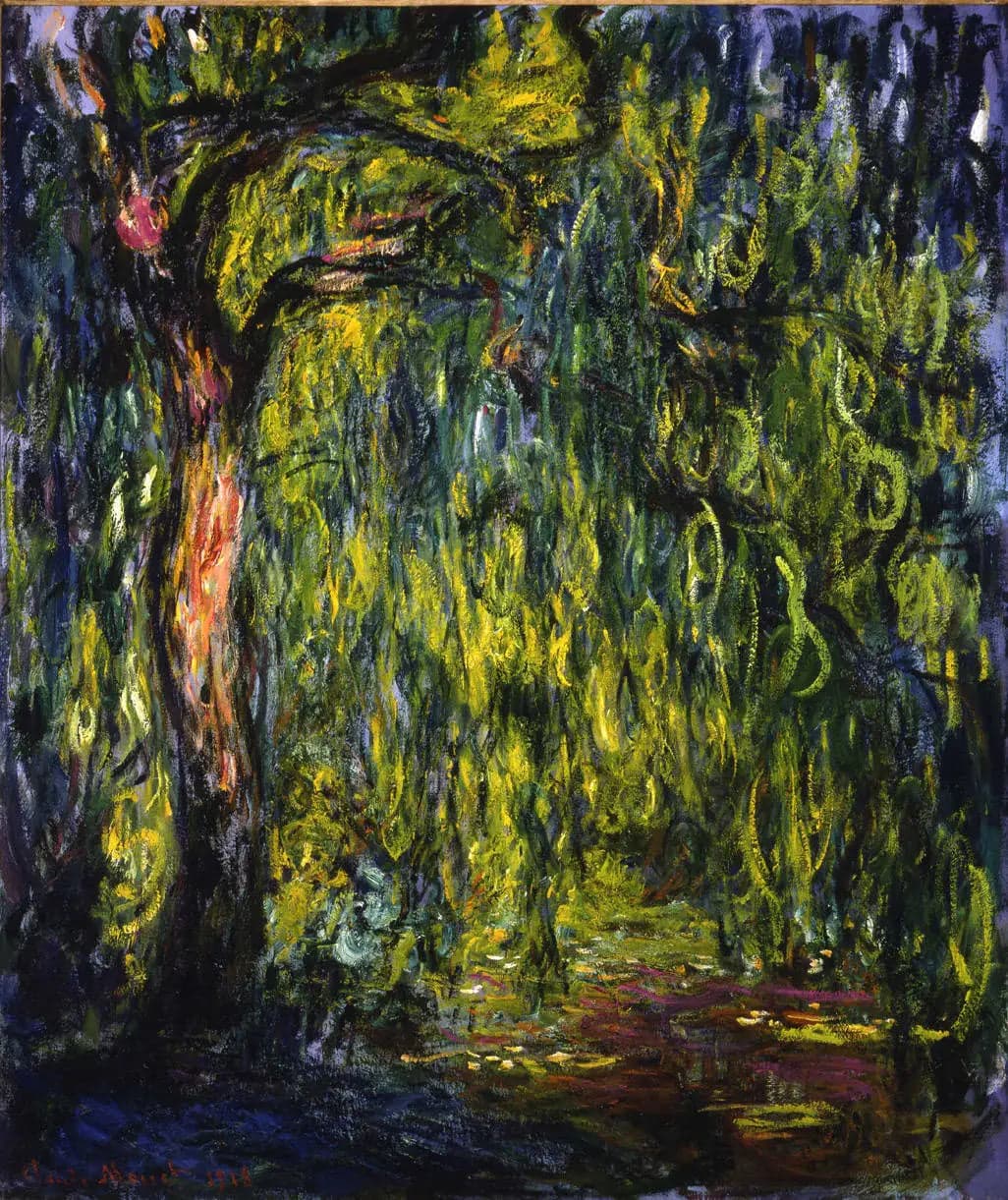
The Weeping Willow
- Original dimensions
- 110.3 x 131 cm
- Museum
- Columbus Museum of Art
- Year
- 1918
Scene depicted
The painting The Weeping Willow captures the essence of a majestic willow, whose branches are gently caressed by the breeze. Monet, with his innovative technique, plays on the reflections in the calm water of a pond, creating a dialogue between the earth, air, and water. This masterpiece testifies to the sublime harmony and changing nuances of the natural world surrounding it, painting a living portrait of the fleeting beauty of the moment.
Historical context
Year: 1918 |BRK| Museum: Columbus Museum of Art |BRK| Dimensions: 110.3 x 131 cm
Place in the artist's career
The Weeping Willow represents a crucial step in Monet's career, fitting into a period of technical mastery and exploration of recurring themes, notably nature. Alongside the famous painting “ Impression, Sunrise ” and “ Water Lilies ”, this canvas illustrates his evolution towards an increasingly free and poetic style, where light and color take center stage.
Anecdote
Monet once declared: “Nature can never be captured in the silence of the canvas, it sings, it cries.” It is with this thought that he created The Weeping Willow , amidst the gentle whispers of a peaceful morning, where light plays harmoniously with the foliage. This fleeting moment became the soul of this pictorial work, a conversation between the observer and the universe.