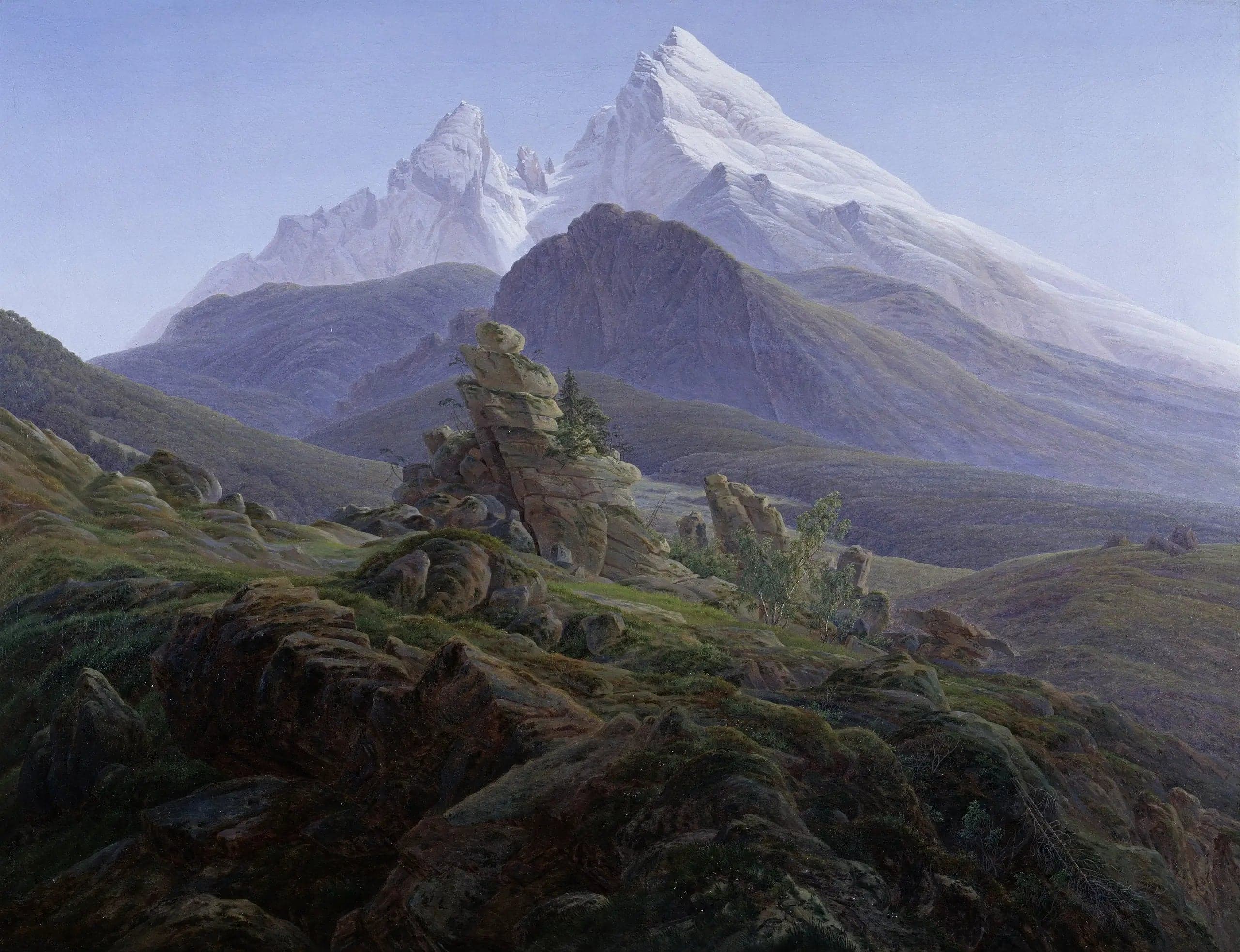
The Watzmann
- Original dimensions
- 170 x 135 cm
- Movement
- romanticism
- Museum
- Alte Nationalgalerie
- Year
- 1820
Scene depicted
The painting "The Watzmann" unfolds a dramatic landscape where the mountain, imposing and mysterious, reigns over a setting of lush valleys. This masterpiece evokes a spiritual quest, that of man in the face of the majesty of nature. The silhouettes of climbers, almost fragile, underscore the overwhelming grandeur of this landscape imbued with melancholy and wonder.
Historical context
Created in 1820, the iconic painting "The Watzmann" by Caspar David Friedrich flourishes in a vibrant German romantic context. The artist, immersed in the majestic landscapes of the Bavarian Alps, captures the very essence of sublime nature. Today, this painting is carefully preserved at the Alte Nationalgalerie in Berlin, where its timeless aura continues to fascinate. Its impressive dimensions of 170 x 135 cm make it a central work that invites contemplation.
Place in the artist's career
"The Watzmann" represents a pivotal period in the career of Caspar David Friedrich , a stylistic peak that accumulates the emotional depth of his earlier creations. By linking it to " The Monk by the Sea " and " The Sea of Ice ", one can observe a marked evolution towards an ever more expressive representation of nature, a dialogue between man and his environment, which became essential in his work.
Anecdote
“My heart beats to the rhythm of nature,” said Friedrich, evoking the inspiration that animated him during the creation of this masterpiece . It was a radiant morning, where the snow-capped peaks of the Watzmann revealed themselves under a azure sky. This moment of peace and grandeur infused this canvas with a powerful evocative force, echoing his deep feelings.