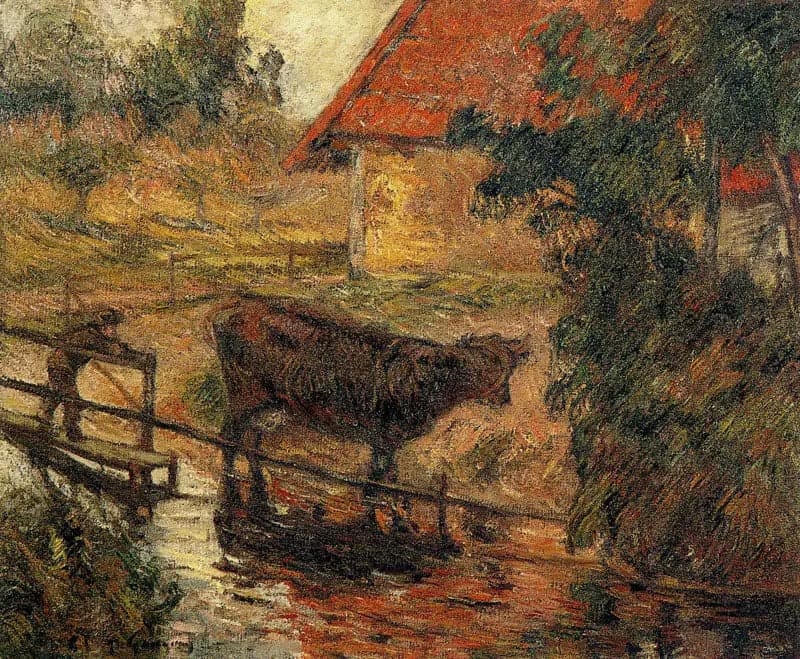
The Watering Place II
- Original dimensions
- 72.5 x 59.5 cm
- Museum
- Shimane Prefectural Art Museum
- Year
- 1886
Scene depicted
The Watering Place II is a vibrant scene where the waters of the watering place mingle with the silhouettes of Breton women interacting with nature. This painting reveals the simple beauty of rural life, imbued with serenity. Through the magic of colors and shapes, Gauguin offers a poetic glimpse into an almost forgotten daily life, suspended in a moment of communion with the elements.
Historical context
Created in 1886, this painting embodies its roots in the artistic effervescence of the late 19th century, in Pont-Aven, Brittany. Adorned with vibrant colors and bold shapes, Gauguin's canvases embody synthetism, a movement that breaks with the conventions of traditional realism . Today, the painting is housed in the Shimane Prefectural Art Museum, reflecting the growing importance of this work in the global artistic landscape.
Place in the artist's career
This painting fits into a pivotal moment in Gauguin's career. In the midst of exploring symbolism , he continues to distance himself from academic norms. Alongside The Vision of the Last Judgment and Christ Before the Crowd , The Watering Place II reveals a stylistic maturation, marking the transition to an even bolder synthesis of emotions and ideas.
Anecdote
“I seek escape in color.” These words resonate through time, recalling Gauguin's state of mind during the creation of this pictorial work . Imagine a May morning, the murmur of streams clinging to silvery reflections, a golden light filtering through the leaves, inspiring the artist to capture this fleeting moment on his canvas .