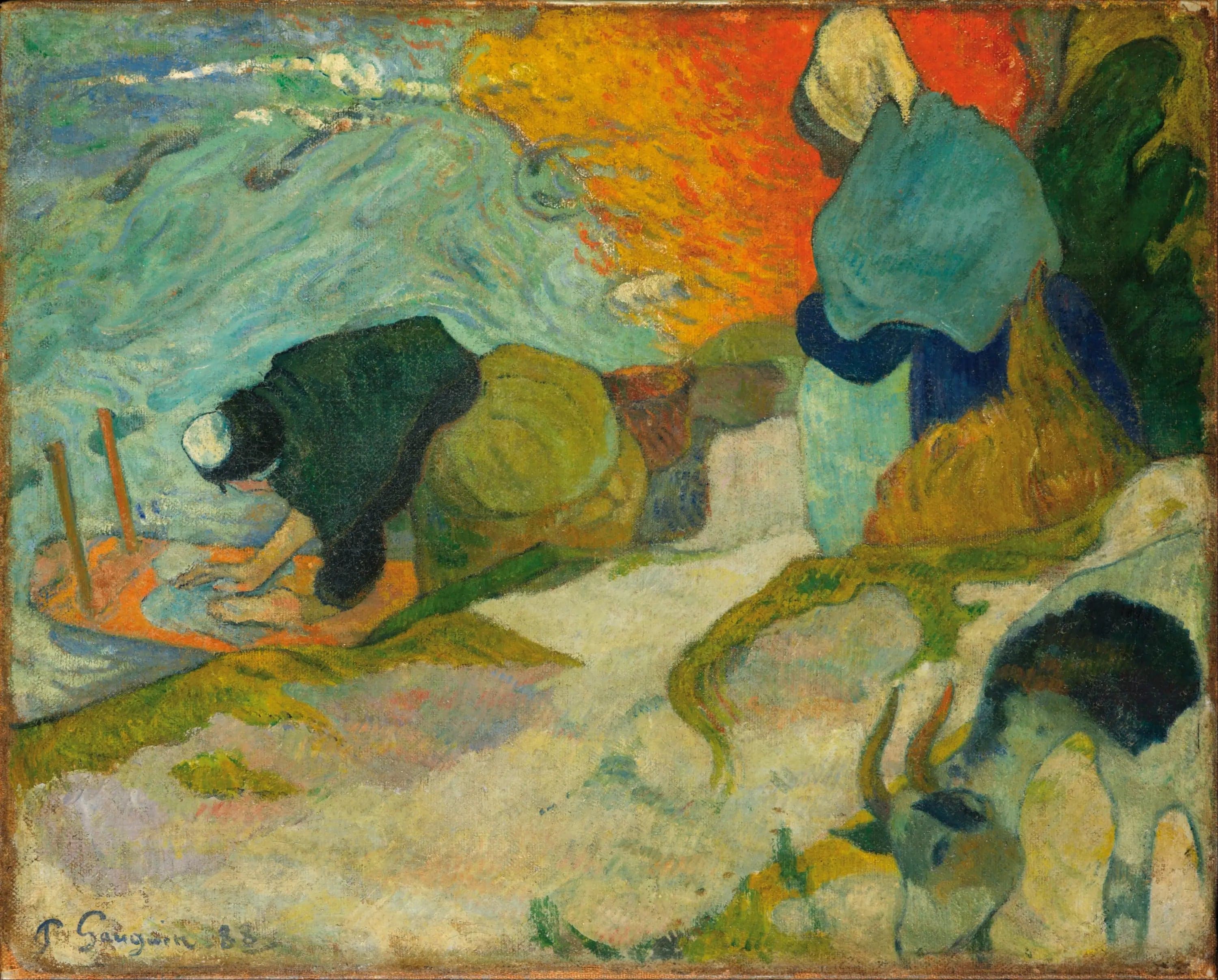
The Washerwomen of Arles
- Original dimensions
- 92 x 74 cm
- Museum
- Bilbao Fine Arts Museum
- Year
- 1888
Scene depicted
“The Washerwomen in Arles” depicts a group of women busy at the water's edge, absorbed in their daily task. This pictorial work illustrates not only humble labor but also evokes a communion with nature. The ripples of the water, the movement of the bodies, and the radiant light create a vibrant scene, where every detail speaks of a tranquil and laborious existence.
Historical context
Created in 1888, in the charming city of Arles, this painting is an iconic illustration of the post-impressionist movement. The creative milieu of this era is marked by a commitment to exploring color and form. Today, this painting is carefully preserved at the Bilbao Fine Arts Museum, attracting art lovers from around the world, amazed by its dimension of 92 x 74 cm.
Place in the artist's career
Inserted in Gauguin's career as a pivotal moment, “The Washerwomen in Arles” represents a phase of his evolving style, the quest for emotional depth through color. In parallel, works like “Vision After the Sermon” and “The Bull” highlight this artistic pathology, seeking to free the soul through pictorial technique and symbolism .
Anecdote
“The light of the south revealed a new palette to me,” Gauguin said, reminiscing about his mornings in Arles, surrounded by the beauty of the landscapes. It was during a walk along the Rhône, on a gentle spring morning, that he felt the need to capture the simplicity of the washerwomen, working with a quiet devotion, reflecting a deep beauty.