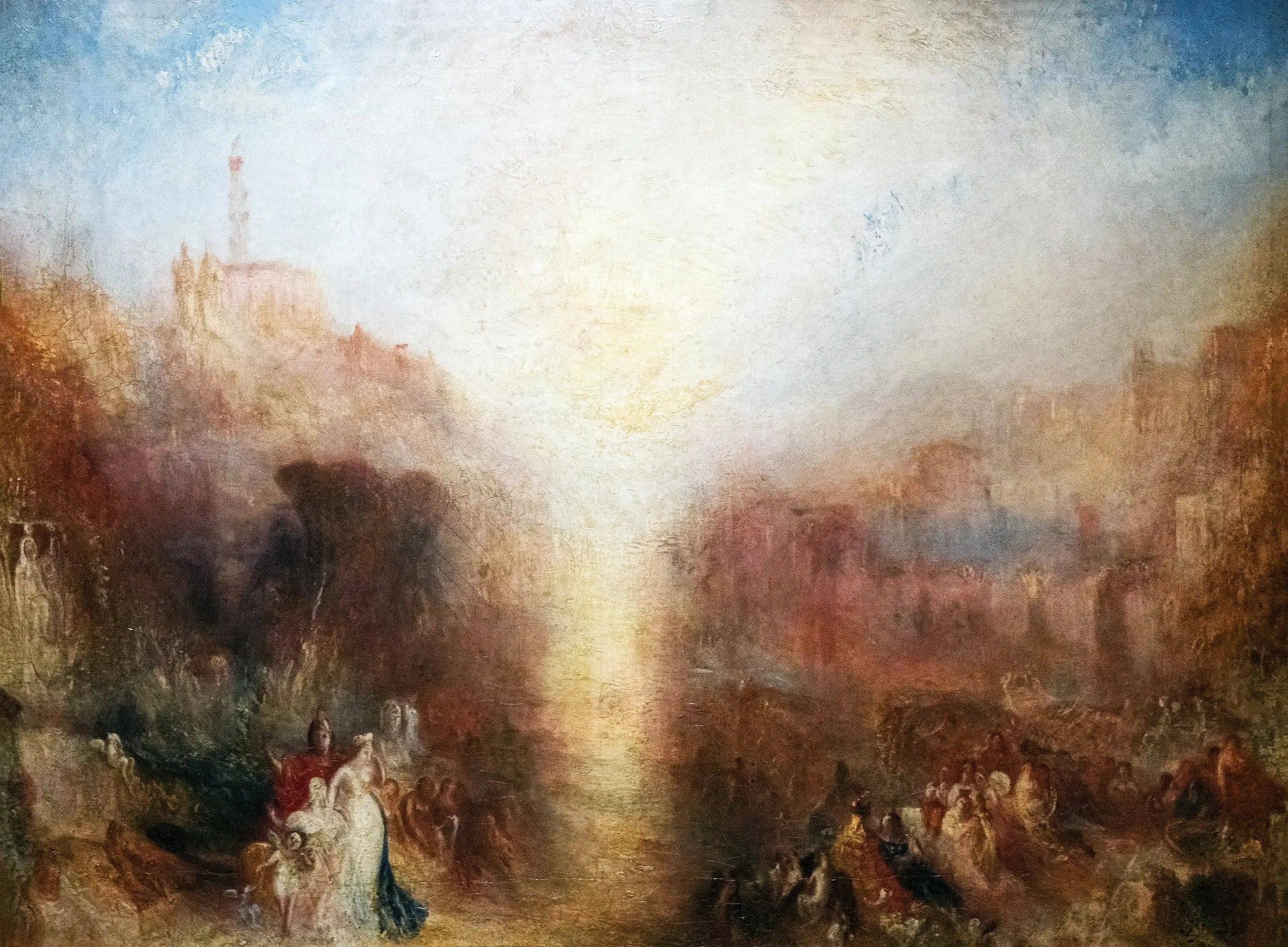
The Visit to the Tomb
Scene depicted
In this canvas , Turner captures the majesty of sacred places, where light caresses the graves and shadows create memories. The human figures, almost ghostly, blend with their environment, forming a communion between the tangible world and the ethereal. The painting represents a scene of reflection, highlighting the notion of memory and the passage of time.
Historical context
Painted in 1834, this iconic work by Joseph Mallord William Turner , a true precursor of the Impressionist movement, was created in London, a city bubbling with creativity at the heart of England. This painting , currently exhibited at the Tate Britain , invites the viewer to a contemplation carried away by the movements of light and the artistic evolution of its time, measuring 91 centimeters in width and 132 centimeters in height.
Place in the artist's career
The Visit to the Tomb is part of a pivotal period in Turner's career, marked by a transition from rigid academicism to greater freedom of expression. Like works such as Rain, Steam and Speed (1844) and the famous The Calm after the Storm (1840), this painting demonstrates the evolution of Turner's style towards brighter and more fluid compositions, engaging the viewer more deeply in emotion.
Anecdote
Turner once stated: "Light is incompatible with time," a phrase that perfectly summarizes the essence of his masterpiece . This painting was born from a fleeting moment, perhaps during a walk on a sunny morning, where his eyes admire the false glory of a landscape through the shadows of a tomb, a striking vision, vibrant with emotions.